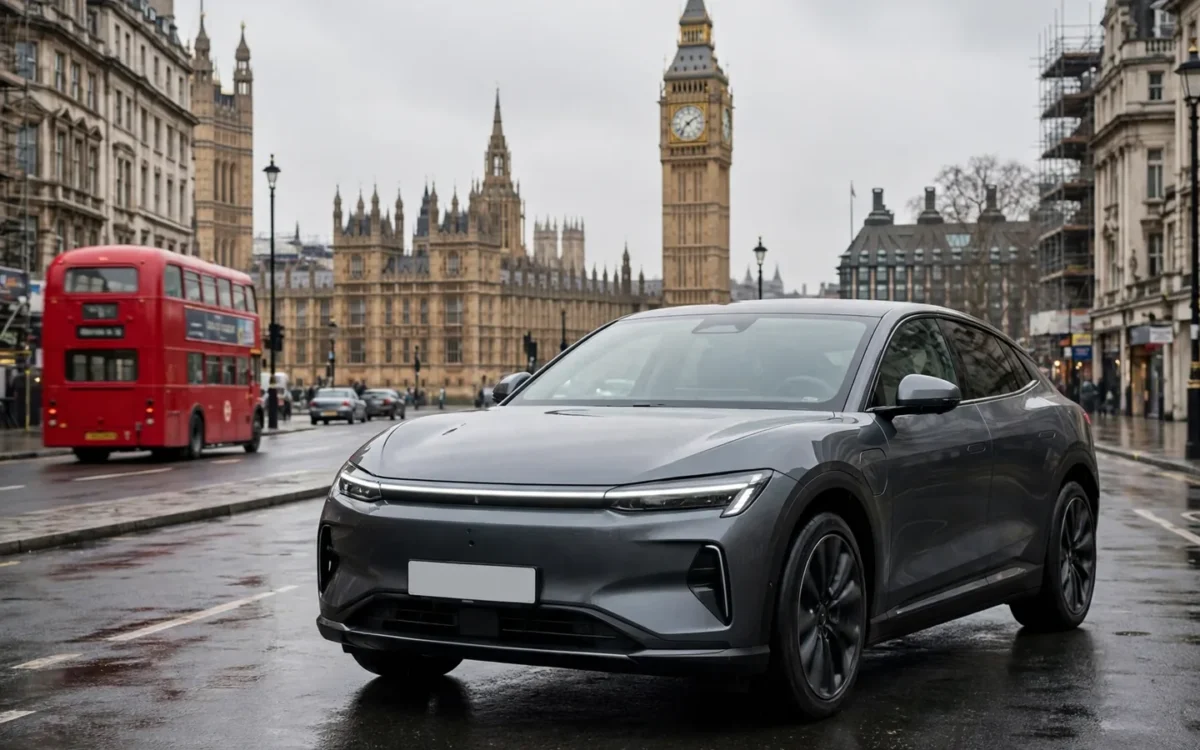
Xiaomi UK ambitions are now hard to ignore. The Chinese technology company has begun recruiting car dealers in right-hand-drive markets, the clearest sign yet that it plans to sell its electric cars in Britain — Europe’s largest market for right-hand-drive vehicles.
The move matters because Britain could be the most straightforward route into Europe for Xiaomi’s cars. Unlike the European Union, the UK has not imposed countervailing duties on Chinese-made electric vehicles, while Xiaomi’s first confirmed European launch — in Germany in the third quarter of 2027 — will face a combined tariff of 45.3 percent. Automotive World reported the dealer recruitment as the strongest indication yet of the company’s British plans.
What did Xiaomi actually say?
Xiaomi president Lu Weibing told investors on the company’s third-quarter results call that dealer recruitment for Europe was already under way on both sides of the road. “Not only have we engaged with dealers in left-hand drive markets but we have also started recruiting dealers in right-hand drive markets,” he said, adding that the European expansion was progressing better than expected and that many dealers had approached Xiaomi themselves.
Lu did not name the UK directly, and a Xiaomi spokesperson declined to comment to Bloomberg. But Britain is the only large right-hand-drive market in Europe, so the recruitment points squarely at it. Chinese media reported earlier in 2026 that Xiaomi planned to begin right-hand-drive sales in 2028, a timetable that fits with the dealer work now under way.
The signal is significant because Xiaomi has so far confirmed only one European launch market: Germany, in the third quarter of 2027. Its first export market anywhere was the United Arab Emirates, which, like the UK, imposes no countervailing duties on its cars.
Why would the UK come before the rest of Europe?
Tariffs are the simplest explanation. When Xiaomi launches in Germany, its cars will face a combined duty of 45.3 percent — the EU’s standard 10 percent car tariff plus countervailing duties aimed at Chinese-made electric vehicles. That is a heavy handicap for a brand trying to win over buyers who have never owned one of its cars.
Britain has taken a different path. The UK has not imposed countervailing duties on Chinese electric vehicles, which leaves the door open for Xiaomi to price its cars more competitively there than in the EU. Tariffs are already reshaping car trade on both sides of the Atlantic, and Xiaomi’s dealer recruitment suggests it is reading that map carefully.
There is also the question of timing. The EU’s import quotas on hybrid cars show how quickly the rules can change for Chinese manufacturers, and UK carmakers have already pressed for a delay to post-Brexit EV tariffs of their own. A British launch would let Xiaomi build a presence, a dealer network and a customer base while the European picture is still unsettled.
Which cars could British buyers get?
Xiaomi has not confirmed a UK line-up, but the candidates are clear from its current range. The SU7 sedan was the car that launched Xiaomi as a carmaker, and the YU7 SUV followed it into the company’s home market. The most recent addition is the Sky Nomad, an extended-range electric vehicle series that includes the N70 and N90 models.
An extended-range model — an electric car with a small petrol engine that charges the battery — could be a shrewd choice for Britain, where many buyers still worry about charging on long journeys. Megawatt charging stations are beginning to cut charging times, but range anxiety remains one of the main reasons drivers hesitate to switch. A car that offers electric driving with a petrol back-up removes much of that worry.
What is not yet known is pricing. Xiaomi built its phone business on undercutting rivals, and its cars have been priced aggressively in China. Whether it can repeat that in Britain — with shipping, dealer margins and local costs — will decide how much of a threat it poses to established brands.
What is the state of Xiaomi’s car business?
The dealer recruitment comes at a mixed moment for the company. Xiaomi’s third-quarter adjusted net profit fell 57 percent to CN¥4.9 billion, a sharp drop that reflects the heavy investment behind its car business as well as pressure in its other markets. Deliveries also slipped 7.2 percent year on year.
That spending is the point, in a sense: Xiaomi is a phone maker that has bet heavily on becoming a carmaker, and the car division is still in its expensive growth phase. The fact that dealers are approaching Xiaomi, rather than the other way round, suggests the bet is being taken seriously by the trade. Carmakers are pivoting as tariffs bite, and a new entrant with strong brand recognition and deep pockets is exactly the kind of partner dealers want.
What do Xiaomi UK ambitions mean for British drivers?
For British drivers, a Xiaomi launch would mean more choice — and probably keener prices — in the electric car market. The company has a reputation for packing features into its products at prices that undercut rivals, and its cars have drawn attention for their design and technology as much as for their cost.
For established brands, it is another warning. Tesla, Volkswagen and the rest already face competition from Chinese manufacturers, and Xiaomi arrives with something most of them lack: a household name built over a decade of selling phones, scooters and home gadgets to millions of customers. The question is whether that brand loyalty transfers from a phone in a pocket to a car on a driveway.
There are also practical questions. A dealer network has to be built, servicing and parts supply arranged, and residual values established — the unglamorous work that decides whether a new car brand survives its first few years in a market. Recruiting dealers is the first step, not the last.
What happens next?
The next clues will come from the dealers themselves. If Xiaomi names UK dealer groups or opens a British sales operation, the launch becomes a matter of when, not if. The 2028 date reported by Chinese media earlier this year is the one to watch, with the German launch in the third quarter of 2027 acting as the test run for Europe as a whole.
Until then, the recruitment is the story: a company that has said almost nothing about Britain is quietly putting the pieces in place to sell cars there. For a market that has spent the last few years arguing about tariffs, quotas and the cost of going electric, that is a development worth watching.
Frequently Asked Questions
Is Xiaomi selling cars in the UK yet?
Not yet. Xiaomi has begun recruiting dealers in right-hand-drive markets, which points to a UK launch, but it has not confirmed a British sales date. Its only confirmed European launch is Germany, in the third quarter of 2027.
Which Xiaomi cars might come to the UK?
The likely candidates are the SU7 sedan, the YU7 SUV and the recently launched Sky Nomad extended-range EV series, which includes the N70 and N90. Xiaomi has not confirmed a UK line-up.
Why is the UK attractive for Xiaomi?
Britain is Europe’s largest right-hand-drive market and, unlike the EU, has not imposed countervailing duties on Chinese-made electric vehicles. Xiaomi’s cars face a combined tariff of 45.3 percent in the EU.
When will Xiaomi launch in Germany?
In the third quarter of 2027, according to the company’s confirmed plans. Germany is its only confirmed European launch market so far.
Has Xiaomi sold cars outside China before?
Yes. The United Arab Emirates was Xiaomi’s first export market for its cars, and like the UK it imposes no countervailing duties on them.
Sources
- Automotive World — Xiaomi signals UK ambitions ahead of its European debut — https://www.automotiveworld.com/news/xiaomi-signals-uk-ambitions-ahead-of-its-european-debut/