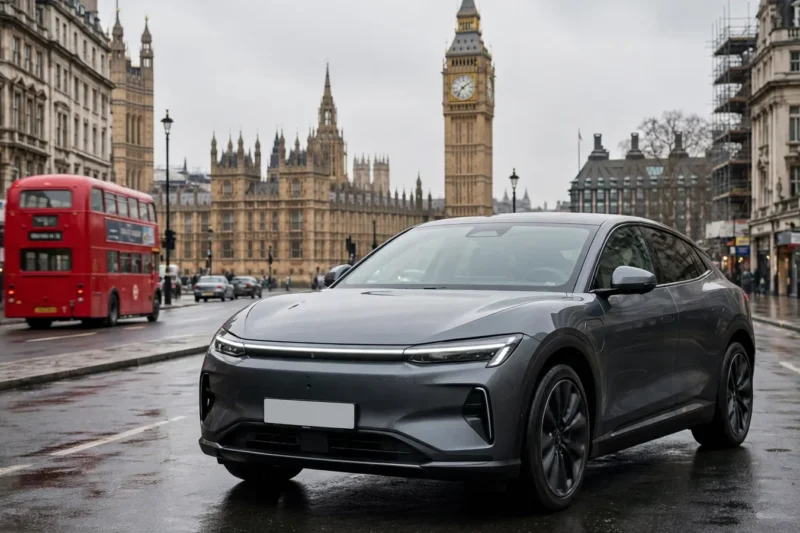
The hybrid car sales surge 2026 has turned into the biggest story in the car industry. Buyers who once waited for fully electric cars are now choosing hybrids instead.
Dealers cannot keep them in stock. Trade policy is pushing the same way.
The result is a sharp change of direction. After years of betting everything on battery-only cars, the industry is pivoting back to plug-in hybrids.
Why is the hybrid car sales surge 2026 happening now?
Fuel prices are the simplest explanation. Petrol has stayed above $4 a gallon in the United States since April, according to AAA data reported in November.
Drivers feel that cost every week. A hybrid that uses far less fuel suddenly looks like the practical choice, not just the green one.
Interest is rising in the surveys too. In the first half of 2026, 22% of shoppers said they would consider a hybrid, up from 20% in 2025, according to Kelley Blue Book.
Only 10% said they would consider a fully electric model in the same period. That gap tells the story of this year in one number.
How fast are hybrids actually selling?
The pace on dealer lots is striking. New hybrids sold in about 44 days in September 2026, compared with 75 days for petrol-only vehicles, according to Cars.com.
As Cars.com put it, hybrids are leaving dealer lots faster than any other fuel type.
Hybrids now make up 12.2% of new vehicles for sale in the US. That is up from 11.4% a year ago and 8% two years ago.
Toyota, Honda, Hyundai and Kia all reported strong hybrid results in 2026.
Which automakers are winning the hybrid race?
Kia said its hybrid sales surged 99% in 2026 over 2025 levels. Hyundai reported a record 33% jump in its hybrid sales.
Honda set an all-time August high for hybrid sales, with more than 36,000 cars sold in the month. Toyota reported 383,091 electrified vehicle sales in one reporting period.
Most of those Toyota sales were hybrids and plug-in hybrids. The company currently offers only one fully electric car, the Toyota bZ.
Some famous nameplates are now hybrid-only. Toyota sells the RAV4 and Camry as hybrids.
What changed in US policy?
Washington changed the maths for buyers and carmakers alike. At the start of the second Trump administration, the $7,500 federal EV tax credit was eliminated.
Funding for electric vehicle chargers approved under the previous administration was also cut.
Carmakers reacted by cutting back many plans for new electric models. As USA Today reported, carmakers have gone all in on hybrids as the electric-only push slowed.
Hybrids they were already making became more attractive overnight. Fuel efficiency mattered more to shoppers, and hybrids were ready to deliver it.
Why are buyers still hesitant about fully electric cars?
Range anxiety has returned. Public charger rollouts have been slow in the US, and home electricity bills have climbed in Europe.
A January 2026 poll found that 20% of 600 potential EV buyers named unreliable charger networks as their top concern about plug-in models.
Hybrids solve that worry neatly. They run on battery for short, low-speed trips and switch to petrol for longer journeys.
There is no need to plan a trip around a charger. For many families, that freedom is worth more than a bigger battery.
What did the EU decide on hybrid imports?
Europe has now put a ceiling on the hybrid wave. The European Union announced that the EU will impose hard import quotas on hybrid passenger vehicles starting Dec. 1.
The 200-day provisional safeguard caps shipments from China while also covering the UK, Japan, Turkey and South Korea. It follows a 49% surge in hybrid imports.
China faces the sharpest squeeze. Its 200-day allowance is capped at 191,800 units, equal to about 350,000 vehicles a year.
That is less than half the 800,000 shipments projected for 2026 without limits. Vehicles above the allotted thresholds will be blocked from clearing customs.
Why did Chinese carmakers pivot to hybrids?
The answer lies in an earlier tariff. In October 2024, the EU imposed countervailing duties on Chinese battery-electric cars, on top of the standard 10% import tariff.
Hybrids were outside that scope. They continued to pay only the 10% base duty, which made them far cheaper to import than battery-only cars.
Chinese makers moved into that gap fast. Their share of Europe’s plug-in hybrid market rose from 2% in 2024 to 25% in the first half of 2026, according to ACEA data.
The new quota closes much of that door. As the Council on Foreign Relations explains in its analysis of Europe’s deal limiting Chinese auto imports, the cap is set at 350,000 hybrids a year.
How is PHEV demand holding up in Europe?
Europe remains the engine of plug-in growth. In October 2026, Europe sold 510,000 electric and plug-in hybrid vehicles, up 36% year-on-year.
Battery-electric cars led the way, up 49% year-on-year. Yet plug-in hybrids rose a more modest 7% year-on-year in Europe in October.
Germany posted its highest EV penetration since December 2022. The UK grew 30% year-on-year.
Globally, battery-electric and plug-in hybrid sales reached 17.5 million in the first ten months of 2026, up 5% on the year before.
What does the automaker electrification shift mean for factories?
Carmakers are now hedging their bets. Nissan and Volkswagen have announced plans for new hybrid versions of popular SUVs.
Ford has shifted its electrification plans to focus more on hybrids. General Motors is exploring electric motors in more of its petrol-powered line-up.
This is the multi-pathway strategy in practice. Instead of one route to lower emissions, makers offer hybrids, plug-in hybrids and battery cars side by side.
Hybrid lines can use existing factories and suppliers, while battery-only plants need huge new investment.
What does this mean for car buyers?
Choice is widening, but prices may rise. Limited hybrid imports into Europe could push up prices for the most popular imported models.
In the US, strong demand and fast-selling stock mean discounts are rare.
Plug-in hybrids offer a useful middle ground. They cover daily commuting on electric power and keep petrol backup for long trips.
Our automotive news coverage will keep tracking prices, waiting times and new hybrid launches as they arrive.
What happens next?
The EU quota runs for 200 days while an investigation continues. Carmakers and importers must plan without knowing whether longer-term safeguards will follow.
Chinese makers are already responding by building factories in Hungary and Spain. Local assembly on European soil would dodge the trade barriers entirely.
Hybrids look set to hold their lead into 2027.
The electric future has not been cancelled. It has simply been delayed.
The hybrid is doing the work in the meantime. More analysis will follow in our automotive section, alongside our latest news coverage.
Frequently Asked Questions
What is driving the hybrid car sales surge 2026?
High fuel prices, the end of the US $7,500 EV tax credit and worries about charging networks have pushed buyers toward hybrids. They save fuel without needing a charger.
What are the EU hybrid import quotas?
From 1 December 2026, the EU caps hybrid imports for 200 days. China is limited to about 350,000 cars a year, with quotas also set for Japan, Turkey, the UK and South Korea after a 49% surge in imports.
Are plug-in hybrids better than fully electric cars?
It depends on the driver. Plug-in hybrids cover short trips on electric power and use petrol for long journeys, so there is no range worry. Fully electric cars are cheaper to run and cleaner locally, but they need reliable charging.
Which automakers are leading the hybrid surge?
Toyota, Honda, Hyundai and Kia reported the strongest hybrid sales in 2026. Kia’s hybrid sales rose 99% year-on-year, while Honda set an August record with more than 36,000 hybrids sold.
Will the hybrid surge last into 2027?
The signs point that way. Carmakers are adding hybrid versions of popular models, and EU quotas plus US policy favour hybrids over imports of battery-only cars. The shift should continue until charging and EV prices improve.