Switzerland’s scenic trains turn a simple journey into the highlight of a whole trip, and the views start the moment you leave the station.
The Glacier Express crosses the country in a full day, while the Bernina Express climbs from palm trees to glaciers in a few hours.
This Switzerland scenic train guide compares both trains, explains the Swiss Travel Pass, and shows how to plan the trip without overspending.
What makes Switzerland’s scenic trains special?
Switzerland runs its famous panoramic trains on ordinary public railway lines, so the same tracks carry local commuters every day.
That means the same mountains, viaducts and valleys are visible from regular regional trains too.
The difference is the experience: panoramic windows, slow speeds, and routes chosen for the view rather than the shortest path.
The two best-known trains are the Glacier Express and the Bernina Express, and they connect at St. Moritz.
A third, the GoldenPass Express, links Montreux and Interlaken in about three hours and fifteen minutes, according to Mobee International’s 2026 round-up of Swiss rides.
What is the Glacier Express like?
The Glacier Express is billed as the slowest express train in the world, and it earns the name.
It links Zermatt and St. Moritz over 291 kilometres in about seven and a half to eight hours.
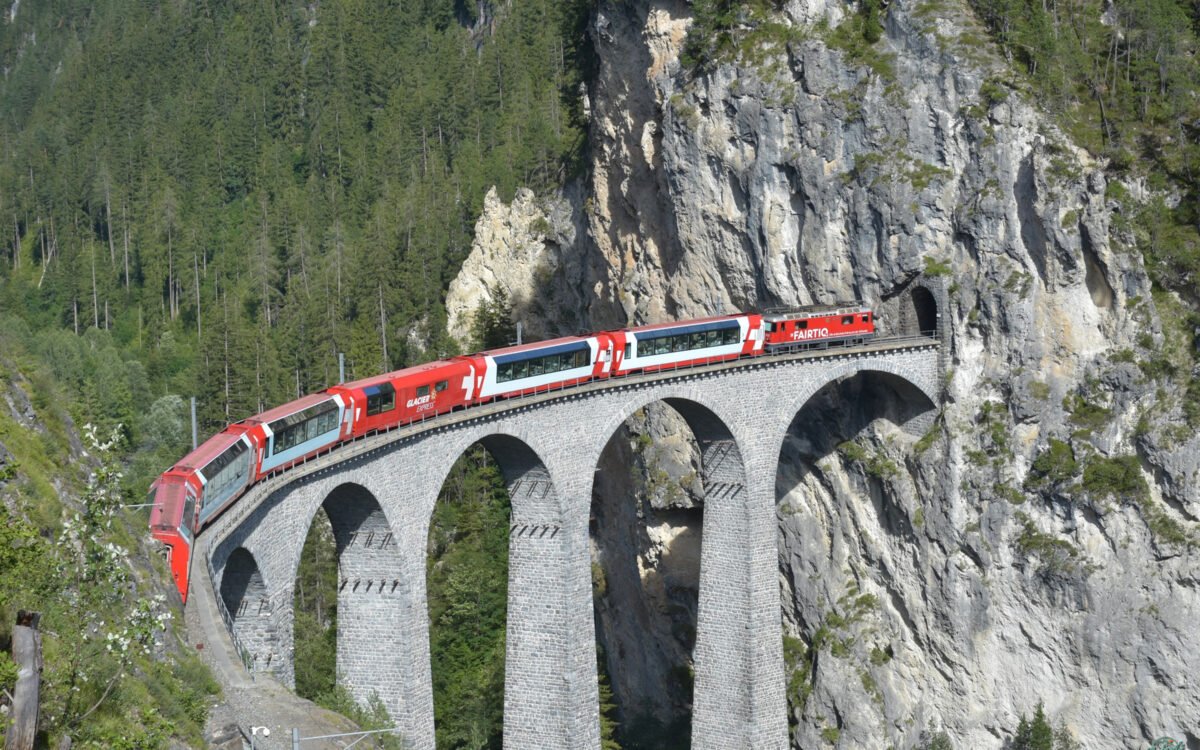
Along the way it crosses 291 bridges and 91 tunnels, and crests the Oberalp Pass at 2,033 metres.
The route passes through the Rhine Gorge, often called the Swiss Grand Canyon, and over the Landwasser Viaduct.
There is no need to change trains, and the train stops roughly twenty times on the full run.
Food is served at your seat, and the panoramic windows stretch up into the roof so the mountains stay in view.
The train runs in both directions, and there is no scenic reason to prefer one direction over the other.
One catch matters for planning: the Glacier Express stops completely for maintenance each autumn.
In 2026 the break ran from 11 October to 4 December, according to The Swiss Travel Pass guide’s comparison of the two trains.
What is the Bernina Express like?
The Bernina Express is shorter, steeper and more dramatic per hour than the Glacier Express.
It runs from Chur, or from St. Moritz, across the Alps to Tirano in Italy, crossing from German-speaking Switzerland into Italian-speaking territory.
From Chur the journey takes about four hours and twenty minutes; from St. Moritz it takes about two hours and fifteen minutes.
The line climbs to Ospizio Bernina at 2,253 metres, the highest point on the route, where the train stops beside a small lake at the pass.
Passengers pass the milky-blue Lago Bianco and the Morteratsch glacier, then spiral down the famous Brusio circular viaduct.
The track curls back under itself in a loop, which is rare in railway engineering and a favourite photo stop.
The Rhaetian Railway line the Bernina Express uses has been a UNESCO World Heritage site since 2008.
Unlike the Glacier Express, the Bernina Express runs all year round, with two trains a day in summer and one in winter.
From Tirano, an optional bus continues on to Lugano, which makes the route easy to combine with Italian Switzerland.
Glacier Express or Bernina Express: which should you choose?
The honest answer is that the two trains offer different kinds of days, not better and worse ones.
The Glacier Express is a full-day commitment, while the Bernina Express is a half-day trip.
If you have only one day, the Bernina Express gives you the most drama per hour, packing glaciers, lakes and a spiral viaduct into a single morning.
If you want a slow, full-day journey with lunch at your seat, the Glacier Express is the classic choice.
| Train | Route | Duration | 2026 reservation | Highlight |
|---|---|---|---|---|
| Glacier Express | Zermatt to St. Moritz | About 8 hours | CHF 54 | 291 bridges, Oberalp Pass |
| Bernina Express | Chur or St. Moritz to Tirano | About 4h 20m or 2h 15m | CHF 32 to 44 | Glacier at 2,253 m, Brusio viaduct |
| GoldenPass Express | Montreux to Interlaken | About 3h 15m | CHF 20 optional | Lakes, pastures, Lake Geneva |
The two routes connect at St. Moritz, so many travellers ride both on consecutive days, using the resort town as a base between the two journeys.
Day one takes the Glacier Express from Zermatt to St. Moritz, and day two continues south on the Bernina Express.
That pairing covers the two most famous Alpine crossings in a single long weekend, and it works well even for travellers short on time.
How much do the panoramic trains cost in 2026?
Every branded panoramic train needs a paid seat reservation, even if you hold a pass, and there is no way around that fee on the panoramic cars.
A pass covers the journey itself, but the reservation fee is charged on top of it, so budget for both parts when you plan the trip.
On the Glacier Express the mandatory 2026 reservation costs CHF 54 in first or second class.
The fare itself is CHF 166 in second class and CHF 284 in first class for the full Zermatt to St. Moritz run.
That means a traveller with no pass pays CHF 220 in second class, or CHF 338 in first class, for the full journey.
The Bernina Express reservation costs CHF 32 from St. Moritz, and CHF 32 to CHF 44 from Chur depending on the season.
Its fares are lower than the Glacier Express, because the route is shorter and the trains are smaller.
For travellers who want luxury, the Glacier Express offers an Excellence Class with a CHF 590 reservation.
That price includes a window seat in the lounge car, a five-course seasonal menu with wine, and luggage transport.
All prices in this section were checked against Patrician’s 2026 fares guide and Orange Travel News in November 2026.
Fares change, so confirm the current price before you book, especially if you are travelling after a timetable change.
Is the Swiss Travel Pass worth it?
The Swiss Travel Pass gives unlimited travel on trains, buses and boats for a fixed number of consecutive days.
It also covers public transport in more than 90 towns and cities, and free entry to more than 500 museums.
The 2026 prices for adults aged 25 and over, in second class, are CHF 254 for three days and CHF 499 for fifteen days.
A six-day pass costs CHF 399 and an eight-day pass costs CHF 439, so the eight-day pass is only CHF 40 more than the six-day one.
First class costs roughly 60 percent more, from CHF 405 for three days to CHF 787 for fifteen days.
A Flex version lets you choose which days to travel within a month, and the three-day Flex starts at CHF 289.
The pass covers the base fare on the Glacier Express and the Bernina Express, but not their reservation fees.
It also covers the Rigi, Stanserhorn and Stoos mountains outright, which is a real saving on a mountain-heavy trip.
Other mountains are discounted rather than free: Jungfraujoch is 25 percent off, while Pilatus and Titlis are 50 percent off.
The pass pays for itself when you move most days and your mountains are the covered ones, which is why a fast-moving itinerary suits it best.
A single-base trip, where you stay in one town and take local day trips, often favours a different ticket instead.
When should you choose the Half Fare Card instead?
The Swiss Half Fare Card is the main alternative to the Travel Pass, and it suits slower trips better.
It costs CHF 150 for one month for visitors from outside Switzerland and Liechtenstein, according to Premier Switzerland’s 2026 price review.
Instead of including travel, it cuts almost every fare by 50 percent, including the mountain railways the pass only discounts.
That matters at Jungfraujoch, the most visited summit in the country, where the pass gives only 25 percent off.
A return to Jungfraujoch from Grindelwald Terminal costs CHF 201.20 at full price, but CHF 100.60 with the Half Fare Card.
The same return costs CHF 151.20 with a Swiss Travel Pass, so the Half Fare Card wins on that single excursion.
Point-to-point fares add up fast in Switzerland, which is why the maths matters before you buy anything.
A one-way second-class ticket from Zurich to Zermatt costs CHF 81 to CHF 119, depending on when you book.
Geneva to Interlaken adds another CHF 47 to CHF 58 each way, according to Planet Patrick’s pass guide.
A simple one-way chain of Zurich Airport to Lucerne, Lucerne to Interlaken, Interlaken to Zermatt and Zermatt to Geneva Airport already costs about CHF 217.
Add one big mountain excursion and the pass usually pays for itself, but a quiet week in one valley rarely does.
The rule is simple: add up your real journeys first, then compare the total with the pass price.
How do you book seats and plan the trip?
Book the Glacier Express weeks ahead in July and August, because its seats sell out in summer.
The Bernina Express is usually easier, and a few days ahead is often enough outside peak season.
Remember that the reservation is compulsory on the Glacier Express for every passenger, pass holders included.
On the Bernina Express the reservation is compulsory on the panoramic cars, but regional trains run the same line.
Those regional trains need no reservation at all, and they follow the identical route over the same passes and viaducts.
If the panoramic cars are full, the regional train is a genuine alternative rather than a poor substitute.
Seat reservations for both trains can be made through the operating railway or the national rail operator.
The trains are popular with tour groups, so weekday departures are usually calmer than weekends.
Winter changes the picture: snow covers the passes, the light is low, and the Bernina Express runs only once a day each way.
Summer brings longer days and two daily Bernina Express departures, but also the biggest crowds.
What should you pack and know before you board?
Panoramic windows are beautiful, but they also reflect light, so a polarising filter helps photographers.
Sit on the right side heading from Zermatt to St. Moritz for the best views of the Rhine Gorge.
On the Bernina Express, sit on the right side from Chur to Tirano for the Landwasser Viaduct and the Brusio spiral.
Bring snacks and water, because the Glacier Express food service is good but not cheap, and the journey lasts most of the day.
Luggage space on the panoramic trains is limited, so travel light or send bags ahead by rail luggage service.
Switzerland uses the Swiss franc, and most stations and trains accept cards, but small mountain cafes may not.
Finally, check the timetable on the day of travel, because Alpine weather can delay mountain railways.
Our Travel Guides section has more route-by-route planning advice, and the wider Travel section covers destinations across Europe and beyond.
The latest travel stories also appear in our News section, which tracks transport and tourism developments as they happen.
FAQ
What is the best scenic train in Switzerland?
The Bernina Express is the best choice for drama per hour, with glaciers, a spiral viaduct and a descent into Italy in about four hours from Chur.
The Glacier Express is the best choice for a full-day journey, with 291 bridges, 91 tunnels and lunch at your seat.
How much does the Glacier Express cost in 2026?
The full Zermatt to St. Moritz fare is CHF 166 in second class and CHF 284 in first class, plus a mandatory CHF 54 reservation.
With a Swiss Travel Pass you pay only the CHF 54 reservation, because the pass covers the fare itself.
Is the Swiss Travel Pass worth it for scenic trains?
The pass is worth it if you travel most days and ride more than one panoramic train, because it covers the base fares.
It does not cover the mandatory reservations, so add CHF 54 for the Glacier Express and CHF 32 to CHF 44 for the Bernina Express.
Do I need a reservation for the Bernina Express?
Yes, a reservation is compulsory on the Bernina Express panoramic cars, and it costs CHF 32 from St. Moritz or CHF 32 to CHF 44 from Chur.
Regional trains run the same line with no reservation, so you can still ride the route if the panoramic cars are full.
Can I ride the Glacier Express route without the panoramic train?
Yes, regular regional trains cover the same route between Zermatt and St. Moritz in about the same time.
They need no reservation, and with a Swiss Travel Pass the fare is already covered, so the journey costs nothing extra.