

Special Lenses Slow Short-Sight Worsening in Children, Trial Finds
A two-year trial has found that special glasses lenses can slow the worsening of short-sight in children. The study covered 125 children aged 6 to 12. Those wearing the new lenses, called Myoslow, saw their short-sight worsen by 24.4 percent less than children wearing ordinary single-vision lenses.
Short-sight, also called myopia, means distant objects look blurry while close objects stay clear. It is common in children, and it often gets worse as they grow. The eye grows too long from front to back, so light lands in front of the retina instead of on it. The retina is the light-sensitive layer at the back of the eye.
The results were published in Scientific Reports on November 28. The trial was funded by the company that makes the lenses, a fact the paper states openly and that readers should know about.
How the Trial Was Run
The trial was run at more than one centre, and it was designed to give a fair test. Children were split at random into two groups. One group wore Myoslow lenses. The other wore ordinary single-vision lenses. Neither the children nor the researchers knew who was wearing which type. That design is called double-masked, and it helps stop expectations from shaping the results.
All 125 children were aged 6 to 12. Each had short-sight between minus 1.00 and minus 5.00 dioptres. A dioptre is the unit used to measure the strength of a glasses prescription. Children with astigmatism — a common condition where the eye is shaped more like a rugby ball than a football — of more than 1.50 dioptres were not included.
The main measure was the change in the children’s glasses prescription over two years. The trial team also measured axial length, which is the length of the eyeball from front to back. In short-sight, the eyeball grows longer as the condition worsens, so a slower growth in length is a sign that the treatment is working. The trial was registered at ClinicalTrials.gov before it began, with the prescription change as its main outcome.
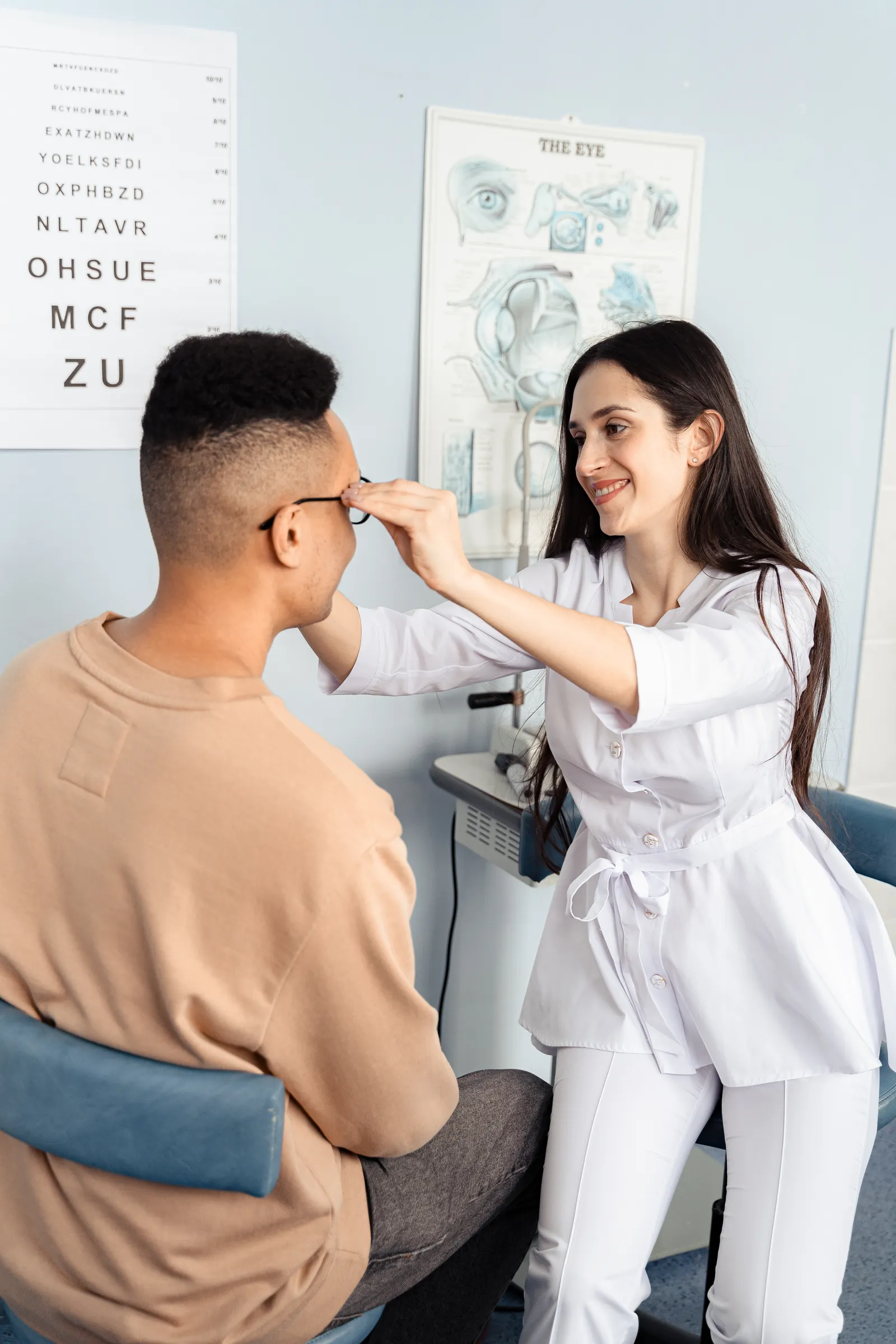
Myoslow lenses use a design called peripheral defocus. The centre of the lens gives clear vision, as a normal lens does. The edges of the lens blur the image slightly in a way that is meant to signal the eye to grow more slowly. The design is based on a method known as Defocus Incorporated Multiple Segments, or DIMS.
What the Results Show
After two years, the children’s prescriptions had worsened in both groups — but less in the Myoslow group. The average change in the glasses prescription was minus 0.86 dioptres for children wearing Myoslow lenses, against minus 1.14 dioptres for children in ordinary lenses. That is a difference of 0.28 dioptres, or 24.4 percent less worsening.
The eyeball measurements told the same story. The average increase in axial length was 0.51 millimetres in the Myoslow group, against 0.65 millimetres in the ordinary-lens group. That is a difference of 0.14 millimetres, or 21.8 percent slower growth.
The paper reports both results as statistically significant. That means the gaps are unlikely to have arisen by chance. The prescription result had a p-value of 0.007, and the eyeball-length result had a p-value of 0.001. In simple terms, a small p-value means the finding is unlikely to be a fluke.
The two measures also moved together. Children whose prescriptions worsened least also tended to show the least eyeball growth. The paper gives a correlation of minus 0.71, which is a strong link. Extra analysis suggested the lenses worked better in younger children, though that finding was exploratory and needs more testing.
The paper also reports a small number of eye events during the trial. None of them were classed as serious. The lenses were generally well tolerated by the children who wore them.
Who Paid for the Study, and Why It Matters
The trial was funded by Crystal Optic Industries Ltd., the company in Israel that makes Myoslow lenses. The paper states that the sponsor took part in designing the study, running it, managing and analysing the data, interpreting the results, and preparing the manuscript.
The paper also lists competing interests. One of the authors works for Crystal Optic Industries. Two others consulted for the company and received payment for that work. The lead author is based at the Goldschleger Eye Institute at Sheba Medical Center in Israel, with posts at Tel-Aviv University and Shaare Zedek Medical Center in Jerusalem.
Funding by a maker is common in medical research. Trials of new drugs and devices are often paid for by the companies that make them. That does not make the results wrong, but it is a fact readers should weigh. Strong trial design helps: this study was registered in advance, run at more than one centre, and double-masked. Even so, the clearest test would be a trial run without the maker’s involvement.
What This Means for Parents
The lenses slow short-sight. They do not cure it, and they do not reverse it. Children in the trial still needed glasses, and their prescriptions still worsened — just more slowly. The size of the effect was modest: a difference of 0.28 dioptres over two years. Over a childhood, that could still add up to a meaningful difference, but it is not a quick fix.
Parents who are interested should talk to their child’s eye doctor. The doctor can weigh the trial results against other options for slowing short-sight, and against the cost and the need to wear the lenses every day. The trial only covered children aged 6 to 12 with short-sight in a set range, so the results may not apply to every child.

Health research moves on many fronts at once. In other recent work, scientists grew brain organoids to study how spaceflight changes genes linked to Alzheimer’s. Dasatinib, a cancer drug, has been repurposed for a rare blood disorder in two sisters. And new health wearables now track biomarkers that once needed a clinic visit. The myopia trial is one more piece of that larger picture.
For now, the message is modest but real. Special lenses slowed short-sight in this trial, and the effect was clearest in younger children. Parents who want to know more should ask their child’s eye doctor — and ask who funded the study behind any claim they hear.
Frequently Asked Questions
What are Myoslow lenses?
Myoslow lenses are special glasses lenses that use a design called peripheral defocus. The centre gives clear vision, while the edges blur the image slightly in a way that is meant to slow the growth of the eyeball and so slow short-sight.
How much did the lenses slow short-sight?
Over two years, children’s prescriptions worsened by 0.86 dioptres with Myoslow lenses, against 1.14 dioptres with ordinary lenses — 24.4 percent less worsening. Eyeball growth was 0.51 millimetres against 0.65 millimetres, or 21.8 percent slower.
Were there side effects?
The paper reports a small number of eye events during the trial, and none of them were classed as serious. The lenses were generally well tolerated by the children who wore them.
Who funded the trial?
Crystal Optic Industries, the company that makes Myoslow lenses, funded the trial and took part in its design, running, analysis and writing. One author works for the company, and two others consulted for it and were paid.


