
Luxury Electric Sedans Reviewed: Range, Ride Quality, and Cabin Tech
The best luxury electric sedans of 2026 have finally grown up. Range has crossed 500 miles, cabins now rival private jets, and charging stops are measured in minutes, not hours.
Yet the class is no longer a one-car story. Four very different flagships now chase the same buyer, and each wins on a different score. This guide compares them on range, ride, cabin tech and real cost.
What makes a luxury electric sedan worth six figures?
A luxury electric sedan must do more than go far on a charge. It has to ride quietly, coddle its passengers, and make its technology feel effortless rather than fussy.
The price spread is wide. Entry points start near $70,000, while flagship trims pass $180,000. That gap buys very different things, so knowing your priority matters more than the badge.
Charging speed is part of the luxury now. A car that adds 200 miles in 20 minutes changes a road trip; one that needs 35 minutes changes your schedule instead.
Which luxury electric sedan goes farthest on a charge?
Range is where the class splits in two. One car leads by more than 100 miles, and the rest cluster within a far narrower band.
Electric Future’s longest-range ranking puts the Lucid Air Grand Touring first at 512 miles of EPA range. No other sedan on sale comes close to that figure.
The Mercedes EQS 450+ follows at 390 miles, while the BMW i7 xDrive60 is rated at 318 miles. The Porsche Taycan 4S trails the group at 316 miles on the EPA cycle.
Real-world driving trims every one of those numbers. AutoEdgeView’s ownership guide warns that highway range runs 15 to 25 percent below EPA stickers in normal use.
How does the Lucid Air Grand Touring earn its range crown?
The Lucid Air Grand Touring costs $114,900 and pairs 819 horsepower with 512 miles of EPA range. It is the longest-range production sedan ever built, according to The Weekly Driver’s buyer’s guide.
Lucid gets there with efficiency, not just a bigger battery. The Air is slippery, light for its size, and runs some of the most efficient motors in the business.
The cheaper Air Pure starts near $69,900 and still offers around 410 miles of range, according to AutoEdgeView. That makes the entry Lucid the range bargain of the class, not just the flagship.
There is a trade-off to weigh. Consumer Reports rated the Air well below segment average for predicted reliability, and the model carries a 17-recall campaign history, as reported by DriveAuthority.
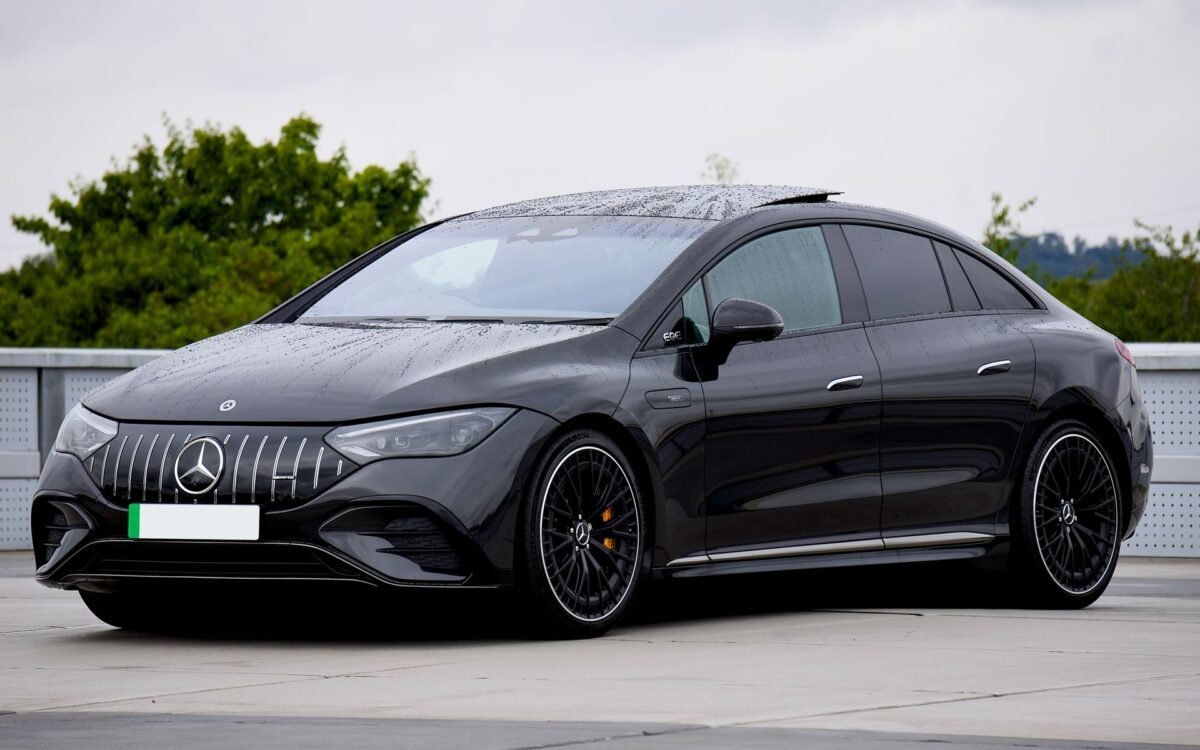
Why is the Mercedes EQS the comfort benchmark?
The EQS is an electric S-Class, and it shows in the ride. Reviewers consistently call its ride quality, noise isolation and seat comfort the benchmarks of the class.
The EQS 450+ starts near $100,000 and is rated at 390 miles of EPA range. DriveAuthority’s three-way comparison notes that Edmunds tested one at 464 miles in real-world driving, far above its sticker.
That real-world result matters more than the headline number. On a long highway run, the EQS may actually travel farther than its EPA rating suggests, which is rare for any electric car.
The EQS also holds its value better than its rivals. DriveAuthority reports it retains roughly 50 to 55 percent of its value at 36 months, ahead of the BMW i7 and well ahead of the Lucid Air.
What makes the BMW i7 the tech flagship?
The BMW i7 xDrive60 starts at $105,700, with 536 horsepower and 318 miles of EPA range. Its party piece sits in the back: an optional 31.3-inch 8K rear-seat theatre screen.
No rival offers anything like it. The screen folds from the roof and turns the rear seats into a private cinema, complete with its own streaming apps and sound system.
The i7’s cabin is widely rated the most opulent from a mainstream maker. Ambient lighting wraps the cabin, and the materials rival the Mercedes S-Class at every touchpoint.
Range is its weak spot, though a cheaper i7 xDrive50 is rated at 364 miles. Buyers who rarely drive far will not notice; frequent road-trippers should check the numbers first.
Is the Porsche Taycan the driver’s luxury EV?
The Porsche Taycan 4S starts at $103,800, with 590 horsepower and 316 miles of EPA range. It is the driver’s car of this group, and it makes no apology for that.
Its 800-volt system peaks at 320 kW, the fastest charging here. AutoEdgeView’s charging figures list a 10 to 80 percent charge in about 18 minutes, roughly half the time of the BMW i7.
Edmunds tested a Taycan 4S from 0 to 60 mph in 3.4 seconds. On the road, its ride is smooth and composed, and it feels more settled than some rivals despite its sporting brief.
The cabin is a technology showcase. Parkers’ Taycan interior review notes three screens as standard, with an optional fourth for the front passenger and a 2026 infotainment overhaul that is faster and easier to use.
Which luxury electric sedan is the best value?
Value in this class is not about the cheapest car. It is about how much range, comfort and technology each dollar buys, and how much the car keeps later.
The BMW i5 eDrive40 starts at $68,550 with up to 310 miles of range, according to Edmunds. It offers most of the i7’s cabin quality at roughly two-thirds of the price, which makes it the quiet value pick.
The Genesis Electrified G80 starts at $76,225 with 282 miles of EPA range, according to Kelley Blue Book.
riiiich’s top-ten ranking calls it the best-value luxury sedan in the class, with a calm cabin and generous standard equipment. A longer-wheelbase 2026 update is reported at 354 miles on the WLTP cycle, so check which version you are buying.
The Lucid Air Pure, from $69,900, is the value play for range buyers. Nothing else near its price travels 410 miles on a charge, which is a serious advantage for long-distance drivers.
Resale is part of the value maths too. DriveAuthority reports the i7 keeps about 48 to 52 percent at three years, while the Lucid Air keeps only about 35 to 40 percent, based on limited data.
How do ride quality and cabin quiet compare?
Ride quality separates the chauffeur cars from the driver cars. The EQS floats over broken roads; the Taycan firms up and talks back through the steering wheel.
Cinch’s road-tested Taycan review praises its balance, grip and smoothness, calling it possibly the first truly great electric vehicle. The low, central battery gives it a planted feel no tall sedan can match.
The BMW i7 splits the difference well. Air suspension keeps it soft in town, yet it stays composed at motorway speed, and its cabin is among the quietest in the class.
Electric cars are quiet by nature, but luxury ones add more. Laminated glass, active noise control and thick insulation turn a whisper into near silence at a cruise.
What cabin tech actually matters in 2026?
Screens are now table stakes, so the difference is how well they work. Laggy menus and buried controls ruin a cabin faster than any missing feature.
The i7’s theatre screen is the headline, but its voice control and driver assistance matter more day to day. The system reads the road ahead and adjusts speed, steering and lane position with little fuss.
The Taycan’s 2026 infotainment overhaul brought a customisable home screen, detailed 3D maps and live charger availability. Parkers notes it switches instantly between Apple CarPlay and the native system.
The EQS leans on its Hyperscreen, a single curved glass panel spanning the dash. It looks spectacular, though some drivers find its touch controls harder to use on the move than physical buttons.
Over-the-air updates now decide how a car ages. Lucid has improved its software steadily, but early owners reported bugs, and buyers should test the current system rather than trust old reviews.
How fast do these sedans charge on the road?
Charging speed decides how a road trip feels. The Taycan’s 320 kW peak is the class leader, and its 18-minute 10 to 80 percent time is hard to beat.
The Lucid Air peaks near 300 kW and needs about 20 minutes for the same charge. The EQS manages 200 kW and about 31 minutes, while the i7 peaks at 195 kW and takes around 34 minutes.
Those gaps matter on a 600-mile day. The Taycan and Lucid need one short stop; the EQS and i7 need a longer one, or two stops instead of one.
Home charging matters more for most owners. AutoEdgeView puts a home Level 2 installation at $1,200 to $3,500, and a full overnight charge then covers almost any daily drive.
What should you check before buying one?
Start with your real driving pattern, not the brochure. A 500-mile car is wasted on a 30-mile commute, while a 300-mile car frustrates on weekly 400-mile trips.
Test the cabin tech yourself, in daylight and at night. Menus that look slick in a showroom can glare, lag or distract once you are actually driving the car.
Check the federal tax credit position carefully. DriveAuthority notes that none of these flagships qualifies for the expired federal EV credit, so do not budget for money that no longer exists.
Finally, look at the dealer and service network near you. A brilliant car with a service centre three hours away is a worse ownership experience than a good car with support nearby.
Luxury EV sedan comparison at a glance
| Model | From | EPA range | Power | Peak DC charging |
|---|---|---|---|---|
| Lucid Air Grand Touring | $114,900 | 512 mi | 819 hp | ~300 kW |
| Mercedes EQS 450+ | $99,900 | 390 mi | 355 hp | 200 kW |
| BMW i7 xDrive60 | $105,700 | 318 mi | 536 hp | 195 kW |
| Porsche Taycan 4S | $103,800 | 316 mi | 590 hp | 320 kW |
| BMW i5 eDrive40 | $68,550 | 310 mi | 335 hp | 205 kW |
| Genesis Electrified G80 | $76,225 | 282 mi | 365 hp | 187 kW |
Figures are US-market 2026 guide numbers as reported by the sources above. Range and charging vary by trim, wheels and temperature, so check the exact version before you buy.
Our car reviews cover more of the class, from family SUVs to performance sedans. Our electric vehicle coverage tracks charging, range and new models as they arrive. See our automotive coverage and latest news for the full range of cars we test.
Frequently Asked Questions
Which is the best luxury electric sedan overall?
There is no single winner, because the class splits by priority. The Lucid Air Grand Touring wins on range, the EQS on comfort, the i7 on cabin tech and the Taycan on driving feel.
What is the longest-range luxury electric sedan in 2026?
The Lucid Air Grand Touring, rated at 512 miles of EPA range on 19-inch wheels. It is the longest-range production sedan ever built, and the next-best rival trails by more than 100 miles.
Is the Tesla Model S still available new?
No, according to reports from early 2026. DriveAuthority reports that Tesla ended Model S production in the second quarter of 2026, so remaining cars are inventory or used-market cars only.
Do luxury electric sedans qualify for the federal EV tax credit?
No, not as new purchases. DriveAuthority notes that none of these flagships qualifies for the federal EV credit, which has expired, so buyers should not count on it in their budget.
How much does a luxury electric sedan cost to run?
Electricity is far cheaper than petrol per mile, and servicing is simpler, with no oil changes or exhausts. The bigger costs are depreciation and insurance, so check both before you sign.
Sources: DriveAuthority, The Weekly Driver, Electric Future, riiiich, AutoEdgeView, Parkers, Cinch and Go-Electra. Figures are as reported by those publications as of 25 November 2026.
Prices, range and specifications are 2026 US-market guide figures — check current prices and specifications before buying. The featured image is a stock photograph for illustration only.