Scenic Alpine Drives of Europe: Grossglockner, Stelvio Pass, and Furka Pass
The best scenic drives Europe has to offer are not motorways. They are mountain roads that climb through hairpin bends to views that stop you in your tracks.
Three Alpine passes stand above the rest. The Grossglockner in Austria, the Stelvio in Italy and the Furka in Switzerland each offer a different kind of thrill.
One is a polished toll road through a national park. One is a legendary wall of 48 hairpins. One is a quiet Swiss pass made famous by James Bond.
This guide compares all three. It covers what each road is like, what it costs, when it opens, and how to plan a trip around them.
What makes these the best scenic drives Europe has to offer?
The Alps hold dozens of fine roads, but these three keep appearing at the top of every list. Each one is a destination in itself, not just a way across the mountains.
The Grossglockner is the most complete experience, with viewpoints, exhibitions and a glacier at the end. The Stelvio is the most famous, thanks to its 48 numbered hairpins.
The Furka is the most cinematic, with its moonscape valley and its Bond film history. Together, they show three different faces of Alpine driving.
All three are seasonal, so timing matters. Our Road Trips coverage explains how to plan around opening dates and mountain weather.
What is the Grossglockner High Alpine Road like to drive?
The Grossglockner High Alpine Road runs 48 kilometres from Fusch in Salzburg to Heiligenblut in Carinthia. It crosses the Hohe Tauern range through 36 hairpin bends.
Construction began in 1930, and the road opened on 3 August 1935. It was built as a scenic route, not a shortcut, and it still feels that way today.
The highest point on the through route is the Hochtor pass tunnel at 2,504 metres. A short spur climbs higher still, to the Edelweißspitze viewpoint at 2,571 metres.
The road is wide and well engineered, with gradients up to 12 percent. It suits ordinary cars, and it is the easiest of the three passes for a first-time Alpine driver.
How much does the Grossglockner cost, and when is it open?
The Grossglockner is a toll road, and the ticket is paid at booths at Ferleiten or near Heiligenblut. In 2026 a car day ticket cost €46.50, with electric cars at €40.00.
Cars entering after 18:00 paid €36.50, and a second day added €17.50. A day ticket covers the whole calendar day, so there is no rush to hurry through.
The road is closed in winter and normally opens around the start of May. In 2026 it opened on 25 April, and daily hours ran from early morning until evening.
Snow or rockfall can still close it at short notice, so check the current status before you go. Discover Austria’s driving guide lists the 2026 season, tolls and opening hours in full.
What should you stop for on the Grossglockner?
The main stops run north to south. Fuscher Törl sits at 2,428 metres, and the cobbled spur to the Edelweißspitze is the highest point you can drive to.
The Hochtor tunnel marks the top of the through route at 2,504 metres. Then the road drops to Kaiser-Franz-Josefs-Höhe at 2,369 metres.
That viewpoint looks across the Pasterze glacier to the Grossglockner itself, Austria’s highest mountain at 3,798 metres. It is the view most drivers remember.
Allow a full half day with stops. The road is a destination, and hurrying through it misses the point. AlpRoute’s Grossglockner fact sheet lists the length, bends and gradients.
Why is the Stelvio Pass so famous?
The Stelvio Pass rises to 2,757 metres, making it the highest paved pass in Italy and the second-highest in the Alps. Its fame rests on one number: 48.
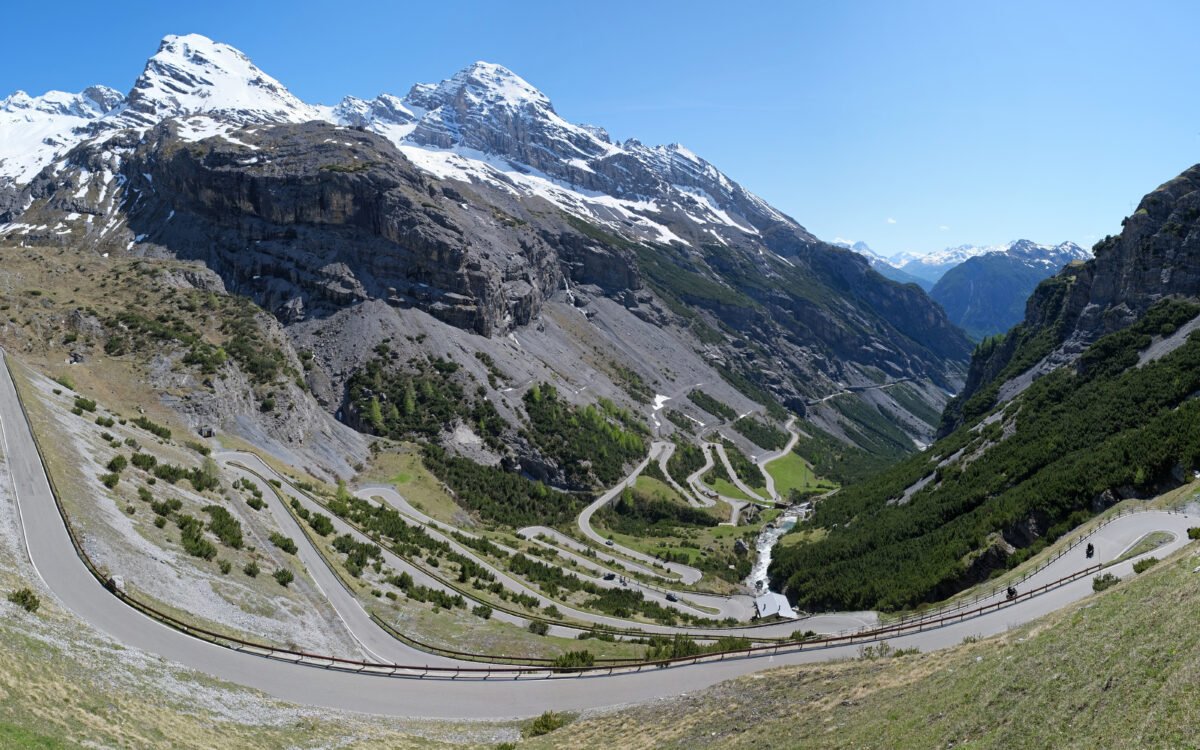
Forty-eight numbered hairpins climb the northern ramp above Prato allo Stelvio, stacked so tightly that from above they look like a coiled spring. No other paved Alpine pass has as many.
The road was built between 1820 and 1825 under the Austrian Empire, as a military and trade route. It took five years of hand labour to carve it from the mountain.
Television made it a legend, and cyclists know it as the Giro d’Italia’s Cima Coppi, the highest point of the race. Dangerous Roads calls it Europe’s most thrilling road.
Which side of the Stelvio should you drive?
Three roads climb to the same summit, and each has its own character. The Prato side is the classic, with 24.3 kilometres and all 48 numbered hairpins.
The Bormio side is shorter at 21.4 kilometres, steeper and more direct, with 36 hairpins of its own. The Trafoi side is the shortest and steepest of the three.
Most drivers climb from Prato and descend to Bormio, so they meet the famous sequence on the way up. Either direction works, and the views reward both.
The road is narrow in places, with gradients up to 16 percent on the steepest ramps. SlowRoads’ Stelvio route guide compares the three approaches in detail.
When is the Stelvio Pass open, and does it cost anything?
The Stelvio is free: there is no toll. That is one reason it draws so many drivers, motorcyclists and cyclists each summer.
It is usually open from late May to early November, though snow can close it without warning, even in summer. The best months are July to mid-September.
August is the busiest month, especially at weekends, so an early start pays off. One day each August the road closes to cars for Stelvio Bike Day.
Fill up in Prato or Bormio before you climb. The summit has parking and cafes, but no fuel pumps. Our Automotive coverage has more on planning a mountain drive.
What is the Furka Pass like to drive?
The Furka Pass crosses the Swiss Alps at 2,429 metres, linking Realp in Uri with Gletsch and Oberwald in Valais. The drive from Realp to Oberwald is 29 kilometres.
The road was built between 1864 and 1866, and horse-drawn post coaches used it until the first postbus crossed in 1921. It feels older and quieter than the other two.
The climb from Realp rises through nine hairpins in its first five kilometres, then eases through alpine pasture. The views open onto the Rhone Glacier below.
Most drivers pair it with the Grimsel and Susten passes for a classic Swiss loop of about 120 kilometres. Sock Monkey’s Furka guide sets out the route facts and history.
Why is the Furka Pass linked to James Bond?
In 1964, scenes from the James Bond film Goldfinger were shot on the Furka Pass. Sean Connery’s Aston Martin DB5 chased a Mustang through its hairpins.
A curve on the road is now signed “James Bond Strasse”, with a lookout and a small car park. It is one of the most photographed bends in Switzerland.
The famous Hotel Belvédère sits in a hairpin above the Rhone Glacier, but it has been closed since 2015. It is still a landmark, and a favourite photo stop.
The pass itself is free, and it is open from late May to early November in a normal year. In 2026 it opened on 29 May and closed for winter on 28 October.
How do the three passes compare?
| Pass | Country | Height | Length | Hairpins | Toll | Season |
|---|---|---|---|---|---|---|
| Grossglockner | Austria | 2,504 m | 48 km | 36 | €46.50/day | May–Nov |
| Stelvio | Italy | 2,757 m | ~47 km | 48 | Free | Late May–Nov |
| Furka | Switzerland | 2,429 m | 29 km | 9+ | Free | June–Oct |
The Stelvio is the highest and the most demanding, with the most hairpins. The Grossglockner is the most polished, and the only one with a toll.
The Furka is the lowest and the quietest, but its glacier views and film history give it a character the others cannot match. Road and Motor’s Alpine guide compares four high roads in detail.
How do you plan a three-pass Alpine road trip?
The three passes sit in three countries, so a single trip needs a little planning. Austria and Switzerland require motorway vignettes, while Italy uses pay-as-you-go tolls.
Switzerland’s annual vignette costs CHF 40, with no short-term version. Austria’s 10-day digital vignette cost €12.80 in 2026. Budget for both before you set off.
The best window is July and August, when almost every pass is open and daytime temperatures at altitude sit between 10 and 20 degrees. September is quieter, with clearer air.
Allow a half day for each pass, and a full day for the Swiss three-pass loop. Our Travel coverage has more ideas for European road trips.
Book stays in the valley towns, not at the summits, where rooms are few and prices high. Plan The Alps ranks the Grossglockner first among Alpine drives.
What should you check before you drive a high Alpine pass?
Check the pass status on the morning you drive. Snow, storms or rockfall can close a road at short notice, even in high summer.
Check your brakes and cooling before a long climb. Hairpins punish both, and a hot engine should never be switched off straight away.
Use a low gear and engine braking on descents, and give way to the yellow PostBus on Swiss mountain roads. It has priority, and it will not wait.
Carry a warm layer, even in July. The summit can feel like late March, and the weather at 2,500 metres changes fast. Our latest news covers travel stories across Europe.
Frequently Asked Questions
Which are the best scenic drives Europe has to offer?
The Grossglockner is often ranked first for the complete experience, with viewpoints, a glacier and smooth roads. The Stelvio is the most famous, and the Furka is the most cinematic.
When is the best time to drive the Alpine passes?
July and August are the safest months, when almost every pass is open. September is quieter, with clear autumn air, but early snow can close the highest roads.
Do you need a special car for the Stelvio Pass?
No, an ordinary car can drive it, but a compact car is easier on the tight hairpins. Check your brakes and cooling first, and use a low gear on the descents.
Is the Grossglockner toll worth it?
For most drivers, yes. The €46.50 day ticket in 2026 bought a full day on a polished road with viewpoints, exhibitions and the glacier at Kaiser-Franz-Josefs-Höhe.
Can you drive all three passes in one trip?
Yes, with three or four days. Drive the Grossglockner in Austria, cross into Italy for the Stelvio, then head west into Switzerland for the Furka, Grimsel and Susten loop.
Sources: Discover Austria, AlpRoute, Dangerous Roads, SlowRoads, Road and Motor, Sock Monkey and Plan The Alps. All figures are 2026 figures as reported by those sources.
Check current tolls, opening dates and road conditions before travelling, as they change with the snow each year. The featured image shows the Stelvio Pass.