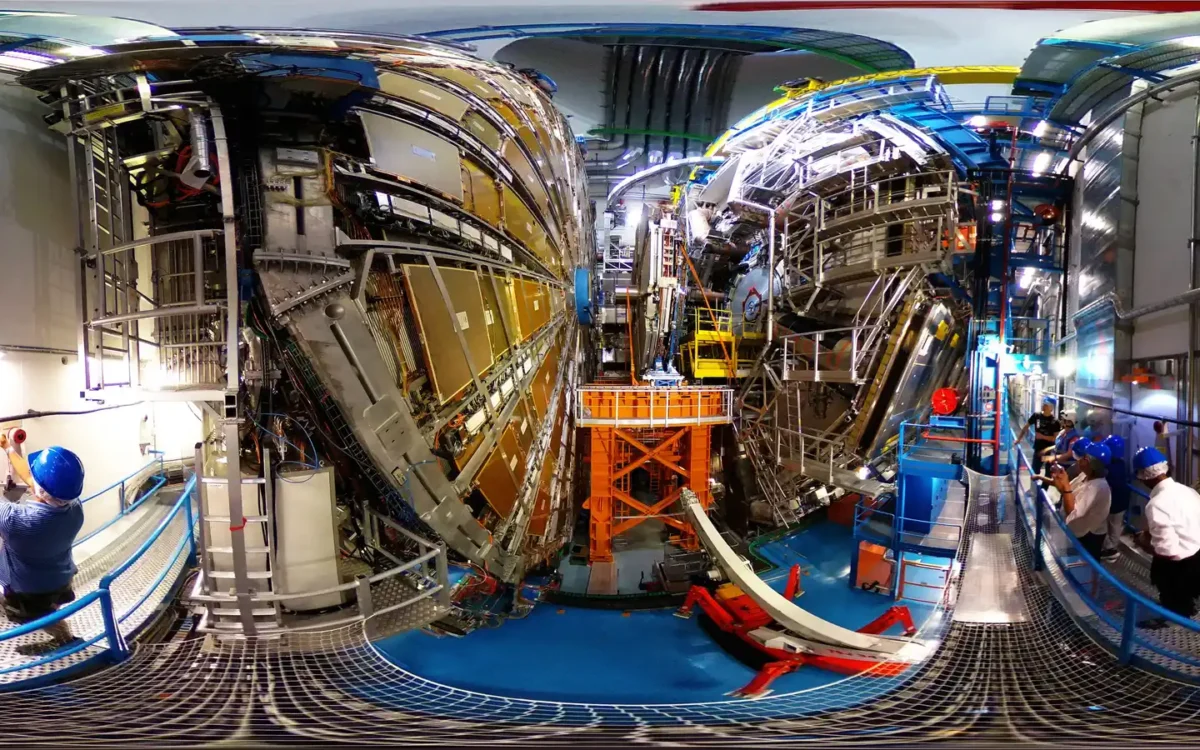
CERN ATLAS Reports Possible First Hint of Vacuum Tunnelling
Physicists working on the ATLAS experiment at CERN say they may have caught the first glimpse of a strange effect called vacuum tunnelling. The ATLAS team reported on November 27, 2026, that it found more of a rare type of particle collision than expected, matching a prediction made 50 years ago.
The effect has never been seen directly. If it is real, it would show that empty space has a hidden structure, and that it can change from one form to another. The team is careful about the claim: the signal is a hint, not a discovery. More data and better models are needed before anyone can say the effect is real.
The result matters because the same kind of physics may help explain why the universe has any matter in it at all. If the Big Bang had made equal amounts of matter and antimatter, the two should have wiped each other out. Yet here we are, made of matter. Something must have tipped the balance.
What is the vacuum, and what is tunnelling?
In everyday language, a vacuum is empty space. In physics, it is not quite empty. The vacuum is filled with force fields, and those fields can be twisted into different shapes. Think of a rubber band that can be twisted once, twice or many times. Each twist is a different state of the vacuum, and the vacuum can, in rare cases, jump from one twist to another. That jump is called quantum tunnelling.
The idea goes back to 1976, when Nobel Prize-winning theorist Gerard ‘t Hooft showed that such jumps could create or destroy matter, at least for the weak force, one of nature’s four basic forces. In the hot early universe, these jumps would have been common.
The strong force, which holds quarks together inside protons and neutrons, has its own version, described by a theory called quantum chromodynamics, or QCD. Jumps in the strong force field are called QCD instantons. They do not create matter, but they can flip the “handedness” of quarks, a property a bit like whether a screw thread turns left or right.
What ATLAS looked for
An instanton event should look like a firework. When it happens inside the Large Hadron Collider, it should burst into many low-energy particles flying out in all directions, forming a round, ball-shaped spray. The trouble is that ordinary proton collisions can make a very similar spray, so picking out the real signal is hard.
To get a clearer view, the ATLAS team used a special set of data recorded in 2015, when the collider was running with very few collisions at the same time. That quiet running gave them a cleaner look at each collision. They then trained neural networks, a form of machine learning, to tell the round spray of an instanton apart from ordinary collisions.
The analysis was led by researchers at the University of Bonn, working with colleagues at Oxford and Prague, as part of the ATLAS Collaboration, which brings together about 6,000 members from more than 240 institutions. The team’s paper was posted as a preprint on November 17, and ATLAS published its public briefing on November 27. It is the first search for QCD instantons ever carried out at the Large Hadron Collider.
The excess in the numbers
In the region most sensitive to instantons, the team counted 32,789 events. Ordinary collisions should explain about 28,800 of them. That leaves about 3,900 extra events that look like they could come from instantons. The excess has a significance of 3.5 standard deviations, a measure physicists use to judge how unlikely a result is by chance alone.
The fitted signal rate was 2.3 times the benchmark prediction, with an uncertainty of plus or minus 0.6 from experimental effects alone. But the theory prediction itself is uncertain by orders of magnitude, so that comparison is hard to read. The search used only 1.6 inverse nanobarns of data at 13 TeV, a small sample by collider standards.
One event stood out in particular. ATLAS published a picture of a candidate event with 12 charged-particle tracks spraying out in a round pattern. The team measured its shape with a number called sphericity-D, and it scored 0.71, close to the roundest possible value of 1. But one event alone proves nothing.
Why it is not a discovery yet
Physicists set a high bar for a discovery: five standard deviations. At 3.5, this result is below that bar. ATLAS says so plainly in its own briefing: “An excess is not yet a discovery.”
There are good reasons for caution. The background of ordinary collisions is hard to model, especially the low-energy interactions between protons that dominate in this quiet data. If the models undercount those ordinary events even slightly, the excess could shrink or vanish.
The theory side is also uncertain. The predicted rate of instanton events spans orders of magnitude, so the theory cannot yet say how many events ATLAS should have seen. As one of the Bonn researchers, Matthias Schott, put it, detecting an instanton would let physicists “begin to measure the topological structure of empty space.”
Why it matters, and what comes next
If instantons are confirmed, it would be the first direct sign that the vacuum can change its shape in a particle collision. That would open a new way to study the imbalance between matter and antimatter, one of the biggest open questions in physics.
The ATLAS team says more data, better models of ordinary collisions and new techniques could settle the question. The LHC has collected far more data since 2015, and future runs will add more. Each new dataset gives the search another chance to see whether the excess grows, as a real signal should, or fades away, as a fluke would.
The result joins a busy year for physics, from the Euclid telescope’s look at the early universe to new milestones in quantum computing. Our latest science reporting has the background on both.
CERN’s other big experiment, LHCb, is also probing the same mystery from a different angle, studying particles that treat matter and antimatter differently. Its recent discovery of an ultra-rare particle decay shows how much the collider can still reveal. The ATLAS result is a hint, not an answer. But it is the kind of hint that keeps physicists searching, because it points at a question the field has wanted to answer for 50 years: what is empty space, really?
Frequently Asked Questions
What did ATLAS actually find?
In its most sensitive search region, ATLAS counted 32,789 events where about 28,800 were expected from ordinary collisions. The excess of about 3,900 events matches the pattern expected from QCD instantons, at 3.5 standard deviations.
Why is this not called a discovery?
Particle physics requires five standard deviations to claim a discovery. At 3.5, the result is a hint. The background of ordinary collisions is hard to model, and the theory prediction is uncertain by orders of magnitude.
What is a QCD instanton?
It is a quantum jump between different twisted states of the strong force field in empty space. The strong force is described by quantum chromodynamics, or QCD. Such jumps should produce a round spray of many low-energy particles and flip the handedness of quarks.
What happens next in the search?
ATLAS plans to use more data, better background models and new techniques to test whether the excess holds up. A real signal should grow clearer with more data, while a statistical fluke should fade.