Carry-On Only Packing System: How to Pack 2 Weeks Into a Single Personal Bag
Two weeks in one bag sounds impossible until you try it. This carry on only packing guide shows how the system works, step by step, so you can travel light without feeling unprepared.
The secret is not clever folding alone. It is a simple rule: pack for seven days, wash once, and let every item earn its place twice over.
Once you trust that rule, the rest of this carry on only packing guide is detail. Bag size, clothing maths, laundry and the personal item all fall into place around it.
Why does carry-on only work for two weeks?
The maths is what makes it possible. You are not packing fourteen outfits. You are packing seven days of clothes, twice, with one laundry session in the middle.
That single wash is the whole trick. Sky Journey Inn’s two-week packing list puts it plainly: pack for seven days and plan one wash around day six or seven.
The rewards are real. No checked-bag fees, no waiting at the carousel, and no risk of lost luggage on a tight connection.
What size bag counts as a carry-on in 2026?
Everything depends on one number: how big a bag your airline lets you take into the cabin. Most full-service carriers have settled on roughly the same size, about 56 x 36 x 23 cm, including wheels and handles.
That is the standard overhead size. A bag of 35 to 45 litres fits it, and that is the range to shop in. Check the measurements with a tape, not by the label on the bag.
Budget airlines are stricter, and the fare matters as much as the airline. A basic fare may include only a small under-seat bag, while the same flight with a priority add-on allows a second cabin bag.
| Airline | Overhead carry-on | Personal item | Weight limit |
|---|---|---|---|
| Delta | 56 x 35 x 23 cm | Small bag, no size given | None stated |
| American | 56 x 36 x 23 cm | 45 x 35 x 20 cm | None stated |
| United | 56 x 36 x 23 cm | Under-seat item | None stated |
| British Airways | 56 x 45 x 25 cm | 40 x 30 x 15 cm | Generous |
| Ryanair (standard fare) | No overhead bag | 40 x 30 x 20 cm | None stated |
| Ryanair (Priority) | 55 x 40 x 20 cm | 40 x 30 x 20 cm | 10 kg |
| easyJet (standard fare) | No overhead bag | 45 x 36 x 20 cm | 15 kg |
| easyJet (large cabin bag) | 56 x 45 x 25 cm | 45 x 36 x 20 cm | 15 kg |
| Emirates (economy) | About 55 x 38 x 20 cm | Small personal item | 7 kg |
| Qantas (international economy) | 56 x 36 x 23 cm | Small personal item | 7 kg total |
The table above follows Roamer Planner’s carry-on size guide, which lists the same limits from airline help pages. IATA publishes a common reference of 56 x 45 x 25 cm, but it stresses that allowances stay airline-specific.
Weight is the hidden trap. Some airlines weigh the cabin bag and the personal item together, and 7 kg total leaves no room for a heavy bag. Weigh your packed bag at home.
If cabin bins are full, even a compliant bag can be tagged for the hold at the gate. That is why the personal item matters so much, as the next sections show.
What is the 5-4-3-2-1 packing rule?
The 5-4-3-2-1 rule is the simplest capsule for two weeks. Five tops, four bottoms, three pairs of shoes, two layers and one hat, all mix-and-match.
Every piece must match every other piece. If an item only goes with one outfit, it stays home. That single test cuts more weight than any gadget.
The rule comes from XANM’s 5-4-3-2-1 guide, which pairs it with one mid-trip laundry session. Five tops and four bottoms give you far more than nine outfits once you start mixing them.
Shoes are the hardest part. Three pairs is the maximum, and most travellers do better with two: the walking shoes you wear on the plane, plus one light second pair.
Two layers cover most weather. A light fleece or sweater handles cool evenings, and a packable rain shell doubles as a windproof jacket.
The hat is optional in practice. A cap or sun hat earns its place on a sunny trip and stays home on a city break in winter.
How does the packing cubes system actually save space?
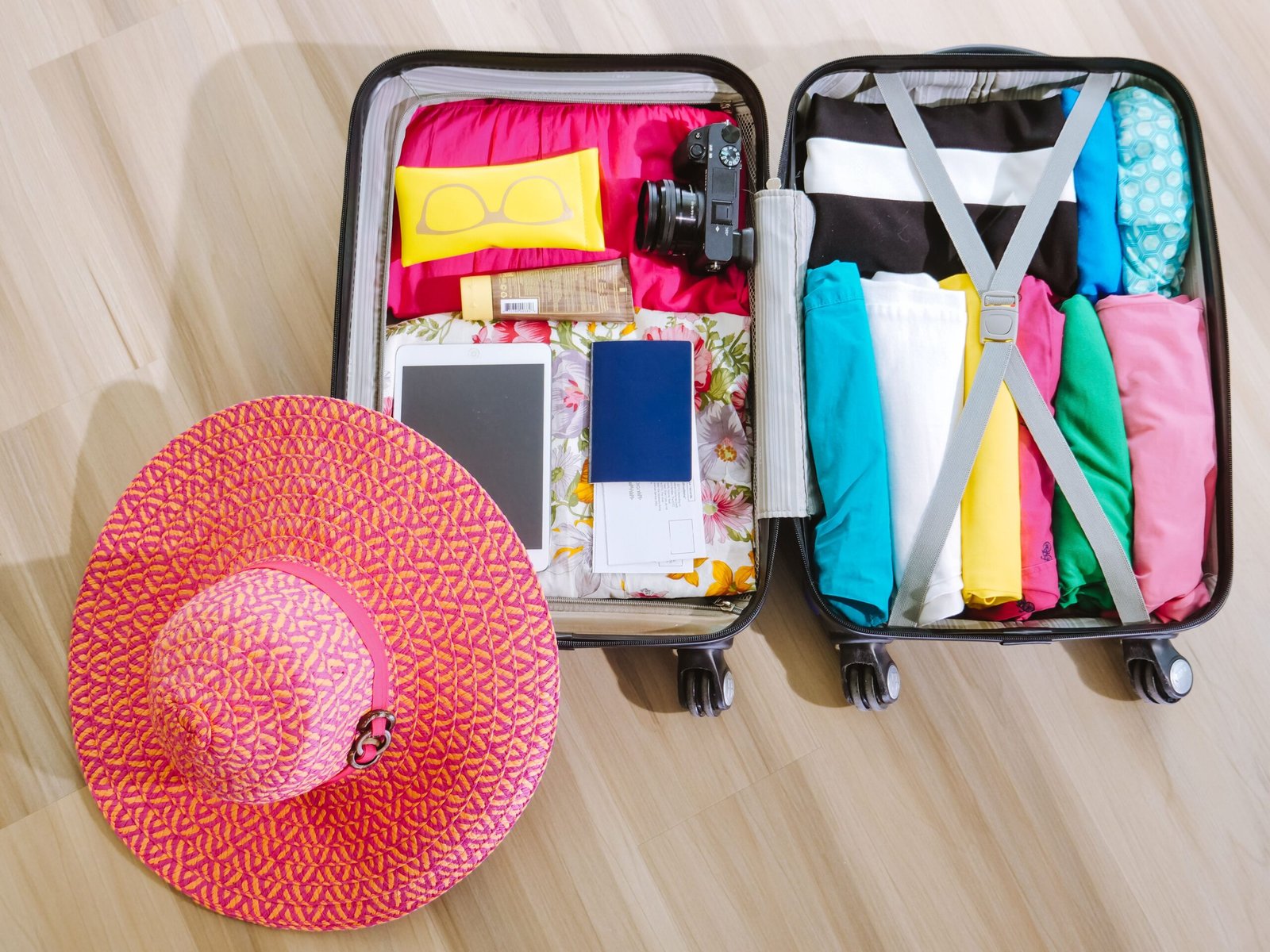
Packing cubes do not work by magic. They are small fabric containers that compress your clothes into organised blocks, so everything has a place and stays put.
The system has four steps. Sort clothing by category, roll each item, pack each cube intentionally, then arrange the cubes inside your bag.
One large cube holds your tops and bottoms. One small cube holds underwear, socks and sleepwear. A third slim pouch takes cables and chargers.
Compression cubes add a second zipper that squeezes the cube down further. They save the most space, but they also add weight, so thin non-compression cubes suit the lightest trips.
SWAE Travel’s packing cube system adds one useful detail: put heavier cubes at the base of the bag and lighter items on top, so the weight sits comfortably.
The real benefit is not space at all. It is access. You can pull out one cube for tonight without unpacking the whole bag, and repacking takes two minutes.
What goes in the personal item?
Your personal item is your insurance policy. It is the small backpack or tote that slides under the seat in front of you, and it holds everything you cannot lose.
Medications, documents, phone, charger and power bank go here first. So does one full change of clothes, in case your cabin bag is gate-checked.
That change of clothes is the detail most people skip. If your bag ends up in the hold, you still have fresh clothes and your essentials for the first night.
Electronics live here too. Spare lithium batteries must stay in the cabin, under IATA safety guidance, so power banks never go in a checked bag.
How do you handle laundry on a two-week trip?
Laundry is what makes carry-on only possible beyond a week. Plan one wash around day six to eight, and the second week takes care of itself.
The cheapest option is the hotel sink. A small tube of travel detergent or a few detergent sheets covers the whole trip, and quick-dry fabrics are dry by morning.
Merino wool and travel synthetics dry overnight and resist odour, which is why they earn their place. Cotton stays damp and heavy, so it is the fabric to leave behind.
A laundromat is the easier option in most cities. It costs little, takes an hour, and you can wash everything at once, including the clothes you wore on the plane.
Pack a tiny laundry kit either way. Detergent sheets, four to six pegs and a thin washing line weigh almost nothing and save you from hunting for supplies.
What about liquids, toiletries and electronics?
Liquids are the tightest constraint in the whole system. Where the security rule applies, they go in containers of 100 ml or less inside one clear one-litre resealable bag.
Solids solve most of the problem. A shampoo bar doubles as body wash, a deodorant stick never spills, and a solid conditioner bar replaces a bottle entirely.
Buy the rest at your destination. Sunscreen, toothpaste and moisturiser are sold everywhere, and carrying full-size bottles wastes space you need for clothes.
Keep the electronics kit small. One charger with two cables, one power bank, and one adapter covers most trips, and a small pouch keeps the cables from tangling.
What should you wear on the plane?
Wear your bulkiest items on the plane. Boots or heavy walking shoes, jeans, your warmest layer and your jacket all belong on your body, not in your bag.
This one habit frees roughly 30 percent of your bag volume, according to XANM’s space multipliers. It is the biggest single space saving in the whole system.
Choose comfort over style for the travel day. You will walk further, stand longer and sit more than on any other day of the trip.
What are the most common carry-on mistakes?
The first mistake is packing for every scenario. The “just in case” outfit is the enemy, and it is almost always the item you never wear.
The second is packing fourteen days of underwear. Seven sets plus one mid-trip wash is enough, and underwear is the smallest item in the bag.
The third is buying a bag that is already too heavy. A 4 kg empty suitcase leaves you almost nothing on a 7 kg limit, so a light bag matters more than a tough one.
The fourth is ignoring the fare. A basic economy ticket may include no overhead bag at all, and discovering that at the gate costs far more than the upgrade would have.
The fifth is overfilling the cubes. A cube stuffed to bursting will not stack, will not zip shut, and will undo the organisation you packed it for.
How do you pack for different climates in one bag?
Layers beat bulk for mixed weather. Three thin layers trap more warmth than one thick jumper, and you can shed them one at a time as the day warms up.
Unsustainable Magazine’s capsule-and-layers method uses the same idea: a tight colour palette, two neutrals plus one accent, so every layer works with every other item.
A packable rain shell is the most versatile item you can carry. It blocks wind and rain, weighs almost nothing, and folds into its own pocket when the sun comes out.
For cold mornings and warm afternoons, add a thin merino base layer. It weighs under 200 grams, dries overnight, and turns a summer outfit into a cold-weather one.
If the trip spans real winter, accept one compromise. Wear the coat on the plane and pack the rest light, because no system fits a parka into a 40-litre bag.
The two-week carry-on packing list
This is the list for a mild-weather trip, roughly 10 to 25 degrees, in a 35 to 45 litre bag plus a small personal item. It follows the same counts in Sky Journey Inn’s tested list and the 5-4-3-2-1 rule.
Clothes
– 5 tops: three T-shirts, one long-sleeve, one smarter shirt or blouse
– 2 bottoms: travel trousers or jeans, plus one lighter pair
– 1 warm layer: a thin merino or fleece jumper
– 1 packable rain jacket
– 7 sets of underwear and 5 pairs of socks
– 1 set of sleepwear, or a T-shirt that doubles up
– 1 swimsuit, if there is any chance of a pool
Shoes
– 1 pair of comfortable walking shoes, worn on the plane
– 1 light second pair: sandals, flats or slim trainers
Toiletries and kit
– Solid shampoo and conditioner bars in a tin
– Toothbrush, small toothpaste, deodorant stick
– Sunscreen, lip balm, any medication
– Travel detergent sheets, pegs, a thin washing line
Electronics and documents
– Phone, charger, one power bank, one adapter
– Passport, booking confirmations, travel insurance details
– One change of clothes in the personal item
Before you zip the bag, lay everything on the bed and remove a third. Quartz Mountain’s minimalist packing guide gives the same advice: if you are unsure whether you need something, you probably do not.
For more ideas in the same spirit, browse our travel tips and travel guides, the wider Travel section, or catch up on the latest travel news before you go.
Frequently asked questions
Can you really pack two weeks with a carry on only packing guide?
Yes. This carry on only packing guide works because you pack for seven days, twice, with one laundry session around day seven. That fits easily in a 35 to 45 litre carry-on plus a personal item.
What size bag do I need for carry-on only?
Most full-service airlines allow about 56 x 36 x 23 cm for the overhead bag. Budget airlines are stricter, so check your fare: a basic fare may allow only a small under-seat bag.
Do packing cubes really save space?
They save some space, mainly through compression cubes, but their real value is organisation. They keep clothes grouped, stop the bag exploding when you open it, and make repacking take minutes.
What is the 5-4-3-2-1 rule?
It is five tops, four bottoms, three pairs of shoes, two layers and one hat, all mix-and-match, for two weeks with one mid-trip wash. Every item must work with every other item.
What should go in my personal item?
Medications, documents, electronics, chargers, a power bank and one full change of clothes. If your cabin bag is gate-checked, the personal item keeps your essentials with you.