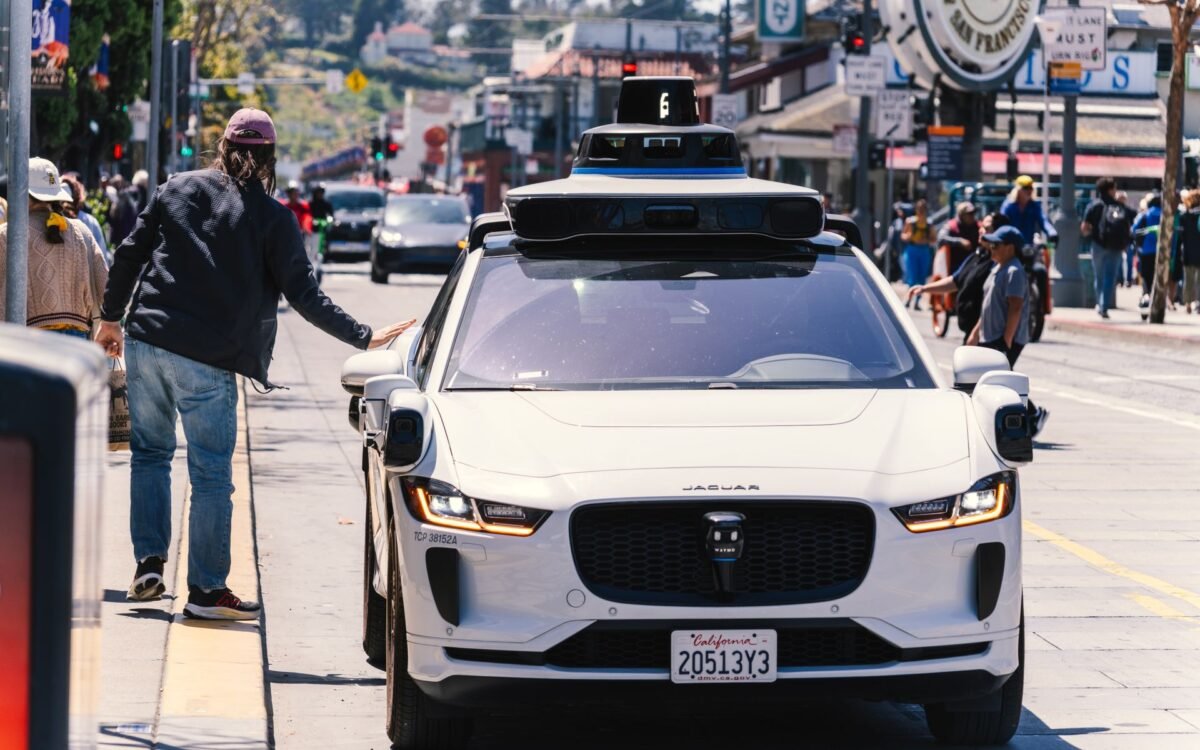
A white car with a spinning sensor on its roof pulls up to the kerb in San Francisco. Nobody is driving it. The passenger climbs in, taps a screen, and the car moves off into traffic on its own.
This is no longer a test. In several major cities, autonomous robotaxis cities now run as paid services, carrying ordinary passengers every day without a human driver at the wheel.
The numbers behind them are striking. Safety data shows far fewer serious crashes than human drivers manage, yet most people still say they would not ride in one.
This guide looks at the safety evidence, the real cost of a ride, and why public trust lags behind the technology in the cities where robotaxis now operate.
What exactly is a robotaxi?
A robotaxi is a car that drives itself as a taxi service, with no human driver on board. It picks up paying passengers through an app, just like a normal ride-hailing car.
Most robotaxis on the road today run at Level 4 automation. That means the car drives itself, but only inside a mapped area and in conditions it is designed to handle.
The cars use lidar, cameras and radar to see the road. If the car meets something it cannot handle, it pulls over safely and calls for remote help.
Which major cities have driverless robotaxis today?
The United States leads in paid driverless rides. The largest operator runs in 15 US metros as of November 2026, including Phoenix, San Francisco, Los Angeles, Austin and Atlanta.
Tesla launched its own robotaxi pilot in Austin in June 2025. It started small, with safety monitors on board, and later expanded to more Texas cities.
China is the other big market. Baidu’s Apollo Go runs driverless rides in 28 cities, most of them in China, plus Dubai. Its largest zone, Wuhan, covers about 3,000 square kilometres.
Europe is moving more slowly. The first paid robotaxi rides there began in Zagreb in 2026, while London is preparing for a launch. Check the urban transport map before you travel, as availability changes often.
How safe are robotaxis compared with human drivers?
The largest operator publishes its crash data openly. Through June 2026 it had driven 271.3 million rider-only miles, with no human driver on board.
Across those miles, its cars were involved in 95% fewer crashes causing serious injury or worse than human drivers on the same roads. That is the headline figure from its safety data hub.
The same data shows 82% fewer crashes in which an airbag deployed, and 82% fewer crashes involving any reported injury. For pedestrians, injury crashes were 93% lower.
These are operator-reported figures, so read them carefully. Comparing crash rates is also hard, because roughly half of all human crashes never reach police records.
What does the independent IIHS study say?
An independent study gives the safety claim a stronger test. The Insurance Institute for Highway Safety analysed 50 million miles of driverless driving from 2021 to 2024.
It compared those miles with 222 billion miles driven by humans in the same four cities. The result was a 68% lower crash rate, with 85% fewer single-vehicle crashes and 81% fewer injury crashes.
City results varied. Phoenix showed a 76% lower crash rate and Los Angeles 71% lower, while San Francisco was closer at 35% lower. Austin went the other way, 4% higher, on a small sample.
Only 64 of the 736 reported crashes happened while the car was driving itself. The institute still warned that crash reporting is incomplete. Read the IIHS robotaxi study report and the same city-by-city results for the full breakdown.
What happened to Cruise, and what did it teach the industry?
The safety story has a dark chapter. In October 2023, a pedestrian in San Francisco was first hit by a human-driven car, then thrown into the path of a Cruise robotaxi.
The driverless car braked hard but ran over her and stopped. Its system failed to detect that she was underneath it, and it tried to pull over, dragging her about 20 feet.
California’s DMV suspended Cruise’s driverless permits on 24 October 2023. Investigators later found the company had not shared the full video promptly with regulators.
General Motors shut the business down in December 2024, after investing more than $10 billion. The lesson is clear: handle rare edge cases safely, and be transparent when things go wrong. See what happened at Cruise for the full account.
How much does a robotaxi ride cost?
A robotaxi ride costs roughly the same as a normal ride-hailing trip, sometimes a little more. The gap has narrowed sharply over the past year.
In January 2026, the average driverless trip in San Francisco cost $19.69, against $17.47 for a standard ride-hailing car and $15.47 for the cheapest rival service.
That put the driverless premium at about 12.7%. In mid-2025 it had been 30 to 40%. Nobody tips a robot, so riders also save the 15% tip a human-driven trip would add.
Prices still move. Between January and April 2026, driverless fares rose 18% in the Bay Area, while the main rival’s rose only 5%. See the 2026 price study of driverless rides and check the app before booking.
Are robotaxis cheaper than Uber or Lyft?
On the headline average, no. A driverless car still costs a little more than a human-driven car on most trips, and clearly more than the cheapest ride-hailing option.
Distance changes the maths. On trips longer than about eight miles in San Francisco, the driverless car often becomes cheaper once the tip is counted.
Wait times are longer too, averaging 5.74 minutes against 3.15 for the fastest human-driven service. There is also no larger vehicle, premium tier or shared ride yet.
For most riders today, the honest answer is near-parity. The driverless car is not the budget option, but it is no longer the luxury one either.
How does the robotaxi business model actually work?
Removing the driver removes the largest cost in ride-hailing. A human driver typically takes most of the fare, so a driverless car keeps far more of each trip’s revenue.
But the car itself costs far more. Sensors, computing hardware and the vehicle platform add tens of thousands of dollars to each car before it earns a single fare.
That is why utilisation matters so much. A robotaxi must run 16 to 20 hours a day to spread those fixed costs across enough trips to make money.
Scale is the other half. Baidu says its Wuhan operation reached unit breakeven, and the largest US operator reported over 500,000 paid rides a week in April 2026. Learn more in our automotive technology coverage.
What is it like to ride in a robotaxi?
Booking feels familiar. You open an app, set a destination, and see the fare before you confirm. A car arrives with nobody in the driver’s seat.
The doors unlock from the app. Inside, a screen shows the route, with buttons for music, temperature and help. There is no small talk and no tipping.
The car drives cautiously and may wait longer at junctions than a human would. If something unusual happens, it can stop and contact remote support. Most riders say the second trip feels normal.
Why do so many people still say no to driverless cars?
The safety data is strong, but public opinion has not caught up. A AAA survey from January 2025 found only 13% of US drivers would trust riding in a self-driving vehicle.
That was up from 9% the year before, but six in ten drivers still said they were afraid of the technology. About 74% knew about robotaxis, yet 53% said they would not ride in one.
Liability worries people most. About 57% want a clear answer on who is legally responsible if a self-driving car crashes, and 49% want to know how vulnerable the cars are to hacking.
Control matters too. About 72% said they would feel safer if they could take over driving if something went wrong. See the AAA report on driver attitudes for the full findings.
What changes people’s minds about robotaxis?
Experience is the strongest converter. A 2026 consumer survey found 38% of Americans are likely to try a robotaxi within the next 12 months, with curiosity the most common emotion at 42%.
Access makes the difference. Among residents of cities with robotaxi services, 35% said they were very likely to use one within the next year, and more than a third had already ridden in one.
Trust follows the same pattern. Nearly a quarter of residents in robotaxi cities fully trust the technology, against just 4% of people without access. Read the 2026 robotaxi trust survey report for more.
What rules govern robotaxis in major cities?
Robotaxis operate under a patchwork of rules. Permits come from state and city authorities, and the requirements differ sharply from one place to another.
In California, operators need permits from both the DMV and the Public Utilities Commission. Those permits can be suspended, as Cruise discovered in 2023. Crashes must also be reported to the federal safety regulator.
Some operators have won special permissions. Zoox received a federal exemption in July 2026 that let it charge fares in a vehicle with no steering wheel. See this 2026 guide to robotaxi companies and cities for the wider picture.
What comes next for robotaxis?
Expansion is the near-term story. The largest operator already serves 15 US metros, and more cities are announced regularly. Each new city needs fresh maps, permits and local testing.
Cheaper vehicles are the next step. Purpose-built robotaxis with no steering wheel or pedals are designed to cost far less than today’s converted cars, which should push fares down over time.
The bottleneck is no longer the technology alone. Public trust, clear liability rules and consistent safety reporting will decide how fast robotaxis spread.
Jobs are part of the debate too. Fleets could displace driving work while creating new roles in maintenance and remote support.
Follow the latest developments in our news coverage and in the wider automotive section as the robotaxi map keeps growing.
Frequently Asked Questions
Are robotaxis safer than human drivers?
The best available data says yes, on a per-mile basis. The largest operator reports 95% fewer serious-injury crashes than human drivers over 271 million miles, and an independent study found a 68% lower crash rate.
How much does a robotaxi ride cost?
In San Francisco in early 2026, the average driverless trip cost about $19.69, against $17.47 for a standard ride-hailing car. There is no tip to add, and fares vary by city and demand.
Which cities can I ride in a robotaxi?
In the US, driverless rides run in cities including Phoenix, San Francisco, Los Angeles, Austin, Atlanta and Las Vegas. In China, Baidu’s Apollo Go operates in 28 cities, plus Dubai.
What happens if a robotaxi crashes?
The operator is generally responsible, since there is no human driver. Crashes must be reported to the National Highway Traffic Safety Administration. Liability rules still vary by state.
Will robotaxis replace Uber drivers and taxis?
Not soon, and not everywhere. Driverless cars still work only in mapped areas, offer no large or shared vehicles, and wait times are longer. The change will be gradual, city by city.
Sources: safety figures come from the IIHS study and the operator’s published safety data hub, as reported by CarScoops, AutoGuide and CleanTechnica.
Fares, trust and adoption figures come from RideWise, AAA, the TaskUs survey and the 2026 robotaxi guide linked above. Availability and rules were current as of 25 November 2026.