High-Speed Rail Expansion Worldwide: Projects Redefining Regional Travel
High speed rail projects worldwide are moving from blueprints to building sites quickly. New lines are opening in Asia, tunnels are being bored under the Alps, and North America is finally laying track for its first true high-speed services.
The scale is striking. China alone now runs more high-speed line than the rest of the world combined, while Europe, India, Morocco and the United States are all building at the same time.
Why Is High-Speed Rail Expanding So Fast Right Now?
Governments are backing rail for three reasons at once: cutting flight emissions, easing road congestion, and linking cities that have outgrown their airports.
A fast train can beat a short flight door to door, because stations sit in city centres and security checks take minutes. Money is following the idea, with rail budgets rising in the European Union, China, India and several African states.
Technology is helping as well. Modern trains run at 320 to 350 km/h in daily service, and new signalling lets trains run closer together safely. That means more trains per hour on the same track, which improves the business case for every new line.
How Big Is China’s High-Speed Rail Network in 2026?
China’s network is in a class of its own. China’s network has passed 50,000 km of high-speed line, according to Railway Gazette International, and the country now holds over 70 percent of all high-speed track in operation.
The network reaches 97 percent of Chinese cities with more than 500,000 residents, based on official figures reported in 2026. That coverage turns the train into the default way to travel between most major cities, rather than a premium option for a few routes.
Growth has not stopped. More than 2,000 km of new line was planned to open during 2026, and the national plan aims for 60,000 km of high-speed line by 2030.
Speed is rising as well. The newest trains run at 350 km/h in regular service, and a next-generation model built for 400 km/h entered pre-service trials in late 2025.
| Project | Route | Scale | Status | Target |
|---|---|---|---|---|
| China network | Nationwide | 50,000+ km | Operating | 60,000 km by 2030 |
| HS2 | London–Birmingham | 225 km | Building | 2036–2039 |
| Chuo Shinkansen | Tokyo–Nagoya | 286 km | Building | No date set |
| Rail Baltica | Tallinn–Poland border | ~870 km | Building | 2032–2034 |
| Mumbai–Ahmedabad | Mumbai–Ahmedabad | 508 km | Building | Late 2027 |
| Kenitra–Marrakech | Kenitra–Marrakech | ~430 km | Building | Before Sept 2029 |
| California HSR | Merced–Bakersfield | 171 miles | Building | 2033 |
| Brightline West | Las Vegas–Rancho Cucamonga | 218 miles | Stalled | Late 2029 |
| Alto | Toronto–Quebec City | ~1,000 km | Designing | 2029–2030 start |
What Is Happening With High-Speed Rail in Europe?
Europe’s biggest story is connection, not just speed. New cross-border lines are joining national networks into a single system, so a train can run from one capital to another without changing at the border.
Under the Alps, the Brenner Base Tunnel is taking shape. The 64 km tunnel between Austria and Italy is planned to open in 2034, according to global rail megaprojects now under construction, and it will remove a long-standing bottleneck for freight and passengers alike.
New services are arriving too. New train journeys to look forward to in 2026 include the return of direct Belgrade to Budapest trains, running six times a day on a rebuilt line.
Why Has Britain’s HS2 Become So Expensive and So Late?
HS2 is the cautionary tale of this building boom. The line between London and Birmingham was first priced at about £33 billion in 2012, but the bill has grown with almost every review since.
The latest figures came in the government’s May 2026 reset of the project, which put the expected cost at £87.7 to £102.7 billion. Two thirds of the increase came from work missed from the original scope, with the rest from inflation.
The timetable has slipped just as far. First trains are now expected between Old Oak Common in west London and Birmingham Curzon Street between May 2036 and October 2039. The full scheme, including London Euston, is not expected until between 2040 and 2043.
The northern legs to Manchester and Leeds remain cancelled, and land on the old route is being sold.
But construction continues: about a third of the whole job is done, and the civil engineering is about two thirds complete. Top speed has been cut to 320 km/h, in line with most European lines.
How Is Japan’s Maglev Line Progressing?
Japan’s Chuo Shinkansen is the most advanced train on earth, and also one of the most delayed. The superconducting maglev line is designed to run at 505 km/h between Tokyo and Nagoya, cutting the trip to about 40 minutes.
The original plan was to open in 2027. That target was abandoned in March 2024 after work in Shizuoka prefecture was blocked for years over concerns about water flow in the Oi River.
Around 86 percent of the 286 km route runs through tunnels, which makes the engineering slow and costly.
There was progress in 2026. Shizuoka’s governor approved the Alpine tunnel section in July, ending a nine-year stand-off. But in November, the operator delayed its promised announcement of a revised opening date.
The cost has risen sharply too, to about ¥11 trillion in October 2025, up 56 percent on the 2021 estimate.
What Is Rail Baltica and Why Does It Matter?
Rail Baltica is Europe’s most strategic new line. The Rail Baltica’s 870 km standard-gauge corridor will link Tallinn, Riga and Kaunas with Poland and the wider European network, ending decades of isolation on a different track gauge.
The Baltic states still run on the old Soviet broad gauge, which stops their trains at the Polish border. The new line uses standard European gauge, with passenger trains designed for 249 km/h and freight at 120 km/h.
Progress is uneven across the three countries. By April 2026, some 267 km of main line was construction-ready, about 43 percent of the first phase.
Estonia is furthest ahead. The timetable has slipped, with Tallinn to Pärnu services now targeted for 2032 and the cross-border section for 2034.
When Will India’s First Bullet Train Start Running?
India’s first bullet train is close to carrying passengers. The 508 km Mumbai to Ahmedabad corridor is designed for 320 km/h, with 12 stations across Maharashtra, Gujarat and the territory of Dadra and Nagar Haveli.
The first section is targeted to open by mid-2027, according to India’s railway minister. Testing and safety checks will follow before any passenger service begins.
The latest update narrows the first opening further. The first passenger service will cover only the Surat–Vapi stretch, in the final quarter of 2027, with the full corridor opening in phases after that.
Costs have nearly doubled, to about ₹2.02 lakh crore, but 456 km of pillar work and 371 km of viaduct are already complete.
How Is Morocco Extending High-Speed Rail to Marrakech?
Morocco already runs Africa’s only high-speed line, the Al Boraq service between Tangier and Kenitra, which opened in 2018. Now the country is extending that line south to Marrakech, turning a northern route into a national network.
Construction of the roughly 430 km Kenitra to Marrakech line began in April 2025. Morocco’s MAD 96 billion rail programme puts MAD 53 billion into the new line, with the rest going to 168 new trains and network upgrades.
The new section is designed for speeds of up to 350 km/h. Once it opens, the Tangier to Marrakech journey should fall to about 2 hours 40 minutes.
That would save more than two hours on today’s trip. Progress was reported at about 30 percent in May 2026, with commercial service targeted for before September 2029.
What Is the State of High-Speed Rail in the United States?
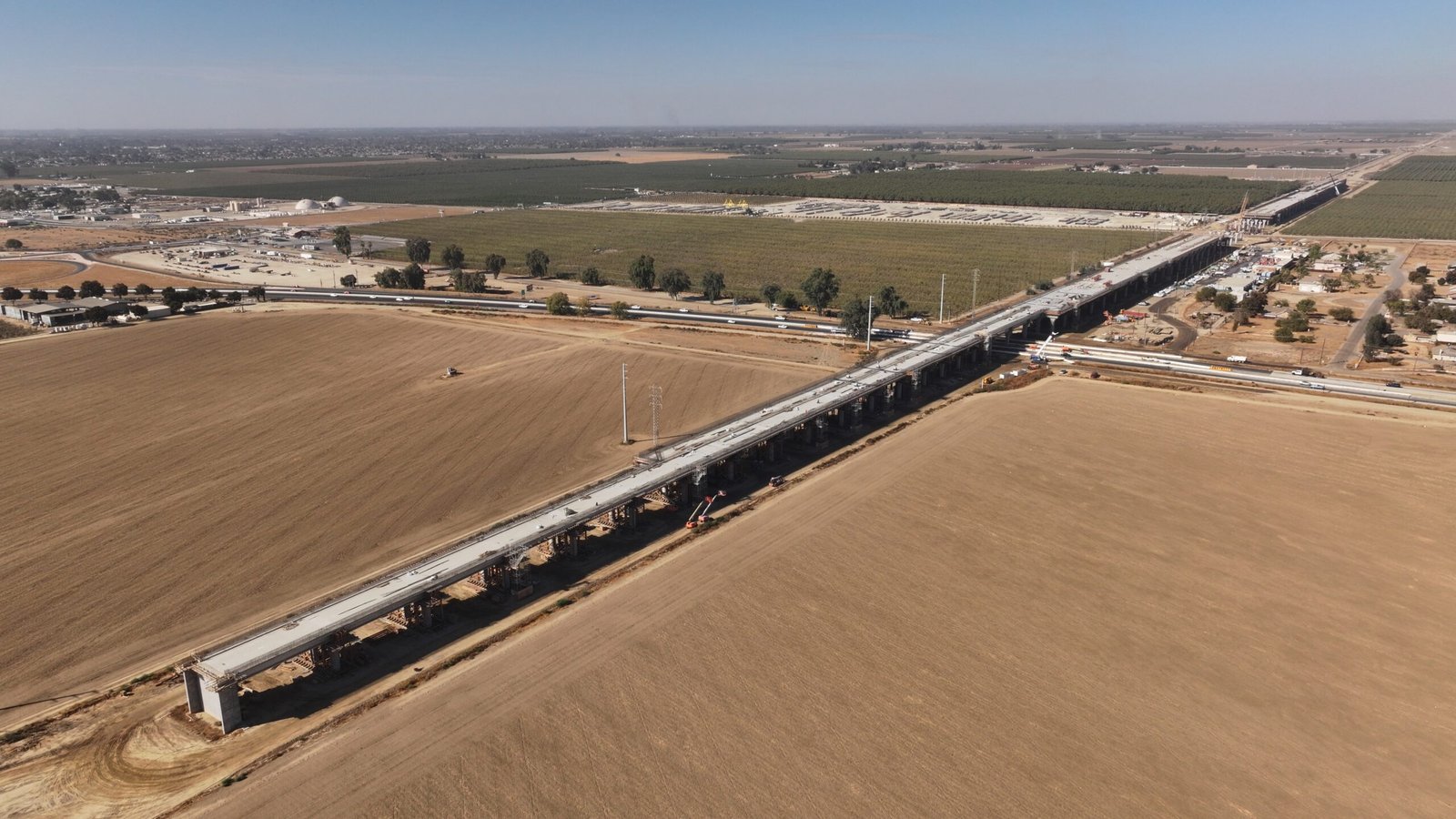
The United States is building high-speed rail in two very different ways. California is building a public line through its Central Valley, while a private company is trying to link Las Vegas with Southern California.
California’s project is moving. There are now 66 completed structures along the first 119 miles of construction in the Central Valley, Railway-News reported in October 2026, with nearly 90 miles of guideway finished.
The next step is track. Track installation began in 2026, after the authority approved a contract in June to lay rail, power and signals. The first operating segment, from Merced to Bakersfield, is targeted for passenger service in 2033.
The cost is the hard part. The full first phase is now estimated at $126.2 billion in 2026 dollars, and funding could run out as soon as December 2027 without new financing.
The private project faces its own test. Brightline West’s 218-mile Las Vegas line broke ground in April 2024.
But work has stalled while the company seeks a $6 billion federal loan. Its target remains late 2029, though delivery would take about four years once financing closes.
Is Canada Finally Building High-Speed Rail?
Canada has talked about high-speed rail for decades without building any. The Alto project, between Toronto and Quebec City, is the first plan to reach serious design work, and it is already one of the country’s biggest debates.
The line would run about 1,000 km on dedicated, electrified track, with seven stations including Toronto, Ottawa, Montreal and Quebec City. Trains would run at 300 km/h or more, cutting the Montreal to Toronto trip to about three hours.
The price is the sticking point. Alto has rejected a cheaper upgrade of the existing corridor, insisting that dedicated tracks are needed for a fast, reliable service.
Its own estimate puts the project at CAD 60 to 90 billion, while critics say upgrading the current line could cost about CAD 11 billion.
The project is still in its co-development phase, with construction of the first segment, Ottawa to Montreal, targeted to start in 2029 or 2030.
How Do New Lines Change Regional Travel?
A new high-speed line does more than save time on one route. It changes which cities people can live in, work in, and visit for a day.
Business travel changes first. Same-day meetings become possible between cities that once needed an overnight stay.
Companies start to treat the whole corridor as one labour market. That is already visible in China, where the network links hundreds of cities into single economic regions.
There is a trade-off too. Fast lines are expensive, and critics in Britain, Canada and the United States all ask whether the money would do more good on local transport.
The answer varies by country, but the building boom shows most governments have decided the case is worth making.
For readers following transportation news, the pattern is clear: high-speed rail is now a core part of national transport plans.
Our Automotive section tracks these projects alongside new vehicle technology, and the automotive technology pages cover the engineering behind faster trains.
What Should Travellers Check Before Planning a Trip?
Opening dates for big rail projects slip often, so treat every date in this article as a target, not a promise. Check the operator’s own announcements close to your travel date, and confirm that the section you want is actually open.
Fares and booking rules vary widely. Some networks sell tickets months ahead with steep discounts for early buyers, while others keep prices flat. Seat reservations may be compulsory, and the cheapest fares can sell out fast on popular routes.
Finally, watch the news. The latest news pages on this site follow transport projects as they develop, and a line that is under construction today can open with little warning once testing is complete.
Frequently Asked Questions
Which country has the largest high-speed rail network?
China has the largest network by a wide margin, with more than 50,000 km of high-speed line in operation — about 70 percent of the world’s total.
How fast do high-speed trains actually go?
Most high-speed trains run at 300 to 350 km/h in daily service. China’s newest trains run at 350 km/h, while Japan’s maglev line is designed for 505 km/h.
When will California’s high-speed rail open?
The authority targets passenger service on the first segment, from Merced to Bakersfield, in 2033. Track installation began in 2026, but funding still has to be secured.
Is high-speed rail better than flying for short trips?
For trips under about 800 km, the train often wins on total journey time, since stations sit in city centres and check-in is quick. For longer trips, flying is usually faster.
What is the fastest high-speed rail project under construction?
Japan’s Chuo Shinkansen maglev is the fastest, designed for 505 km/h between Tokyo and Nagoya, but it has no confirmed opening date. The fastest conventional lines run at 350 km/h.
Sources: Railway Gazette International, GOV.UK, Railway-News, Simple Transit, Spotatrain, Mathrubhumi, Gujarat Samachar and Le360.
Travel Tomorrow, Railway Supply, LopoRail, Railway News and the International Railway Journal were also used. Project dates, costs and speeds change, so check current project status before planning a trip.