
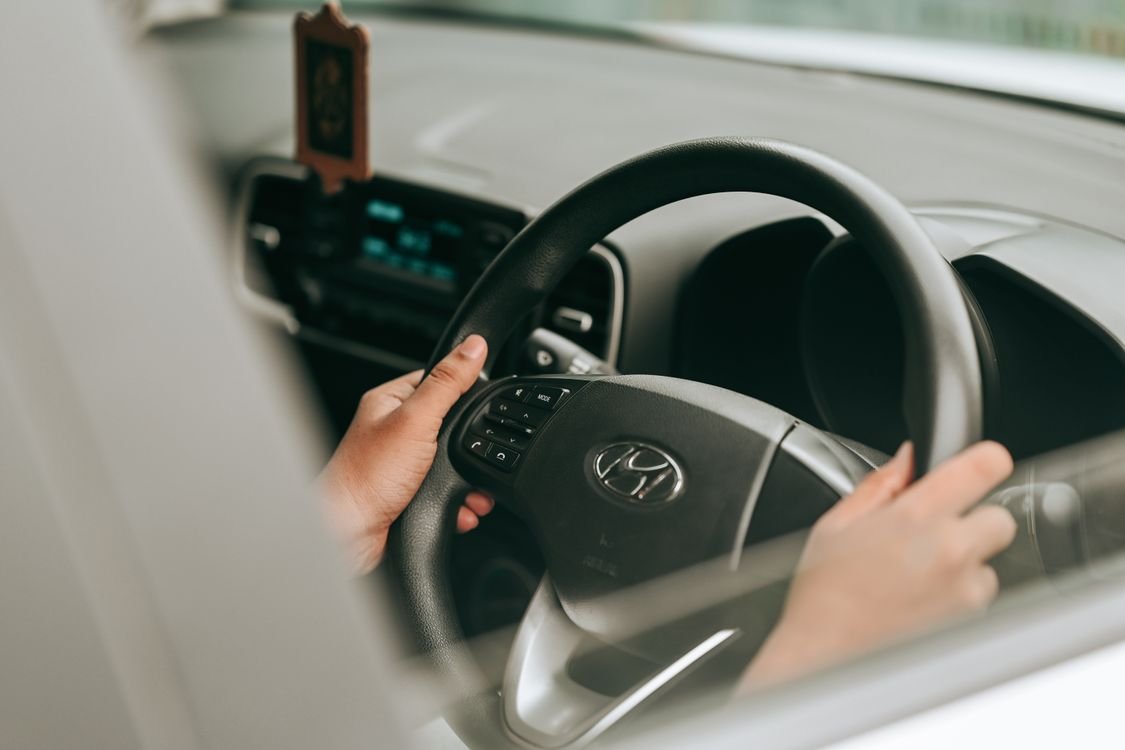
Steer-by-Wire and Active Suspension: How Digital Chassis Tech Transforms Handling
Steer by wire technology is quietly rewriting how cars handle. It cuts the steel column between your hands and the front wheels and replaces it with sensors, software and motors.
Active suspension does the same for the ride. It reads the road many times a second and pushes back against bumps, lean and dive before you feel them.
Together, the two systems turn the chassis into software. This guide explains how they work, which cars already use them, and what they mean for drivers.
What Is Steer by Wire Technology?
Steer-by-wire is a steering system with no physical link between the wheel and the tyres. Your steering input travels as an electronic signal, not through a metal column.
Sensors measure how far and how fast you turn the wheel. A controller reads that signal and tells a motor at the steering rack to turn the front wheels.
A second motor on the column pushes back against your hands. It creates the weight, the centring and the road feel that the old column used to transmit for free.
The idea is not new, but it took decades to reach showrooms. Early systems struggled with safety, cost and the simple problem of making a wheel feel natural.
How Does Steer-by-Wire Actually Work?
Every steer-by-wire system has two halves that only talk through wires. The steering wheel actuator reads your input, while the rack actuator turns the wheels.
The wheel-side unit carries angle and torque sensors, usually duplicated for safety. It also carries the feedback motor that simulates resistance and self-centring.
The rack-side unit carries its own electric motor, which does the physical work of turning the tyres. A controller sits between the two and translates intent into motion.
That controller does far more than pass signals along. It sets the steering ratio, blends in driver-assistance commands and filters out harsh kicks from the road.
A detailed explainer of how steer-by-wire works describes the two-actuator layout and the safety architecture behind it. It is the clearest starting point for the engineering.
Why Did Steer-by-Wire Take So Long to Reach Production?
The first production attempt arrived in the 2013 Infiniti Q50. It kept a clutch-based mechanical backup, and its early feel disappointed many reviewers.
The core problem was trust. A mechanical column cannot fail silently, but software and wiring can, so regulators and engineers demanded proof of safety first.
The industry answered with redundancy instead of a backup shaft. Modern systems run dual controllers, dual power supplies and multiple communication links between the two halves.
That approach is now production-proven. The slow road to market was mostly about solving failure modes, not about the basic idea of electronic steering.
What Changes When the Steering Ratio Becomes Software?
In a normal car, the steering ratio is fixed by gears. A steer-by-wire car can change it in software, moment by moment, as speed and conditions change.
At parking speeds the ratio can be very quick, so a small turn of the wheel moves the tyres a lot. At motorway speeds it relaxes, so the car stays calm and stable.
This is what makes a yoke-shaped wheel possible. With a full sweep of only about 340 degrees, there is no need for hand-over-hand turning in tight spaces.
The ratio can even change inside a single steering input. That flexibility is impossible with a fixed mechanical rack, and it is the system’s biggest everyday benefit.
Which Cars Use Steer-by-Wire Today?
The most famous example is the Tesla Cybertruck, which ships steer-by-wire as standard with no mechanical backup. Its yoke sweeps 340 degrees from lock to lock.
The Cybertruck’s ratio runs from about 5:1 at a crawl to 12:1 at high speed, according to MotorTrend. Its rear wheels also steer by up to 10 degrees.
Mercedes-Benz confirmed steer-by-wire for the facelifted EQS in 2026, becoming the first German maker to bring it to production. Lexus fits it to the RZ in some markets too.
A guide to which production cars use the system lists the current models and notes that availability still varies by region. Check local specifications before assuming a feature is offered.
How Safe Is a Steering System With No Mechanical Backup?
Steer-by-wire is engineered to ASIL D, the highest safety level under the ISO 26262 standard. That is the same target as a car’s braking circuit.
The Cybertruck uses two steering motors working together, so one alone can still steer the truck to safety. One motor runs on 48-volt power and the other on the high-voltage battery.
Its steering inputs are triple-redundant, with two main sensors and a third acting as a tie-breaker. If the two main sensors disagree, the third decides the correct reading.
Regulation is catching up too. China’s GB 17675-2025 standard, in force from 1 July 2026, formally permits electronic steering with no mechanical backup at all.
What Is Active Suspension?
Active suspension replaces fixed springs and dampers with a system that controls wheel and body movement in real time. Sensors, software and actuators work together at each corner.
Unlike a passive setup, it does not only react to the road. It anticipates and counteracts body roll, pitch and vertical movement before the driver feels them.
A driver’s guide to active suspension defines it as a system that manages vertical wheel movement independently at every corner. That independence is the key idea.
The result is a car that can be soft over bumps and firm in corners at the same time. Old suspensions forced engineers to choose one or the other.
How Do Active Suspension Systems Work?
Every active system runs the same three-part loop: sense, decide, act. Sensors are the eyes, the control unit is the brain and the actuators are the muscles.
Accelerometers, wheel position sensors and yaw sensors feed data to the controller many times a second. Steering angle, speed and brake pressure are part of the picture too.
The controller calculates the exact force or damping change each wheel needs. Then the actuators execute that command, often in milliseconds.
In the most advanced systems, those actuators are electric motors. One production design uses a 48-volt motor able to apply up to 1,120 pounds of force per damper.
What Is the Difference Between Active, Semi-Active and Passive Suspension?
A passive suspension has fixed characteristics while you drive. Its springs and dampers react to the road, but no controller changes them in real time.
A semi-active system adjusts damping as you drive, softening or firming the ride. But a damper can only resist motion; it cannot push back against the road.
A fully active system can add force and move the wheel on its own. It can lift a wheel over a bump or push it down into a dip, even with no prior road input.
The table below sums up the three types in plain terms, so you can see at a glance what each system can do and where its limits lie.
| Type | What it can do | Limit |
|---|---|---|
| Passive | Fixed springs and dampers react to bumps | No real-time change |
| Semi-active | Damping adjusts in milliseconds | Can only resist motion |
| Fully active | Adds force and moves each wheel | Needs power and costs more |
A guide to Skyhook and Groundhook control explains the two control ideas behind these systems. Skyhook prioritises body comfort, while Groundhook prioritises steady tyre grip.
Which Production Cars Use Active Suspension Today?
Porsche’s Active Ride controls pitch and roll on the Taycan, using damper technology from supplier ZF. The same hardware family appears in the Panamera.
ZF’s sMOTION system can lift a car by 80 millimetres in under half a second. Its maker says it can hold a three-tonne car almost level at up to 1 g of cornering force.
Mercedes-Benz fits E-Active Body Control to its largest luxury cars. Its updated Maybach GLS, introduced in July 2026, adds cloud-informed damping that learns from other cars.
ClearMotion supplies active suspension for the NIO ET9, while BWI Group confirmed its MagneRide system for the Polestar 5 in September 2025. The technology is spreading beyond luxury flagships.
How Do Steer-by-Wire and Active Suspension Work Together?
Steering and suspension used to be separate systems that barely talked. In a digital chassis they share sensors, data and one central controller.
That matters because steering and body motion are linked. A sharp turn creates roll, and roll changes how the tyres grip, so the two systems must agree.
Software can coordinate them in real time. The suspension can firm up the outside wheels as the steering ratio quickens, keeping the body level through a corner.
This coordination is why suppliers now sell chassis software, not just parts. One market report on software-defined suspension values the segment at 480 million dollars in 2026 and projects 1.65 billion by 2031.
What Will the Digital Chassis Mean for Drivers?
The first change is comfort without compromise. A car can glide over rough roads and still stay flat and planted when the road turns twisty.
The second change is personalisation. Drive modes already change steering weight and damping, and software-defined chassis will make those differences larger and more precise.
The third change is safety. A chassis that senses a skid early can steer, brake and adjust each wheel together, faster than any driver could react.
There is a trade-off, though. More software means more to go wrong, and repairs may need specialist diagnostics rather than a simple mechanical fix.
What Should Buyers Check Before Choosing One?
Start with the basics: is the system standard, optional or unavailable on the exact trim you want? Availability varies widely by market and model year.
Ask how the car behaves if a sensor or actuator fails. A well-designed system should warn you clearly and keep the car safely controllable.
Test the steering feel yourself on a test drive. Some drivers love the quick, light response, while others miss the weight and feedback of a mechanical rack.
Finally, check running costs. Active suspension parts and software updates can be expensive, so ask about warranty cover and service intervals before you sign.
For more on where car technology is heading, see the Automotive Technology section and the wider Automotive section. Electric models are leading much of this change, as covered in our electric vehicles pages and the latest automotive news.
Frequently Asked Questions
Is steer by wire technology safe without a mechanical connection?
Yes, when it is built to the ASIL D safety standard. Production systems use duplicated sensors, controllers and power supplies, so a single failure does not leave the car unsteerable.
Can a steer-by-wire car still be steered if a motor fails?
In the best-known production design, yes. Two motors steer the front wheels together, so one motor alone can guide the car to a safe stop if the other fails.
What is the difference between active and adaptive suspension?
Adaptive suspension is semi-active: it changes damping but cannot add force. Active suspension can push and pull each wheel, controlling body movement directly.
Do active suspension systems use a lot of power?
Fully active systems do use meaningful power, which is why many run on 48-volt or high-voltage supplies. Semi-active dampers use far less, since they only resist motion.
Will steer-by-wire become standard on all new cars?
Probably not soon. Analysts value the steer-by-wire market at 3.2 billion dollars in 2026, growing to 4.32 billion by 2030. Expect it first in premium and electric models.
Sources: Auto-Tech-News, TheFixCar, MotorTrend, Not a Tesla App, BandM Auto Care, Coilovers.com, EVKX and Knowledge Sourcing.
Full source URLs are listed in the article frontmatter. Figures are reported 2026 guide figures; check current availability and prices before buying.