Hera Reveals Stadium-Sized Crater on Dimorphos After NASA DART Impact
Four years after NASA deliberately crashed a spacecraft into an asteroid, we can finally see what the collision did. The European Space Agency’s Hera mission has released the first close-up images of Dimorphos, and the Dimorphos crater it found is far bigger than many scientists expected.
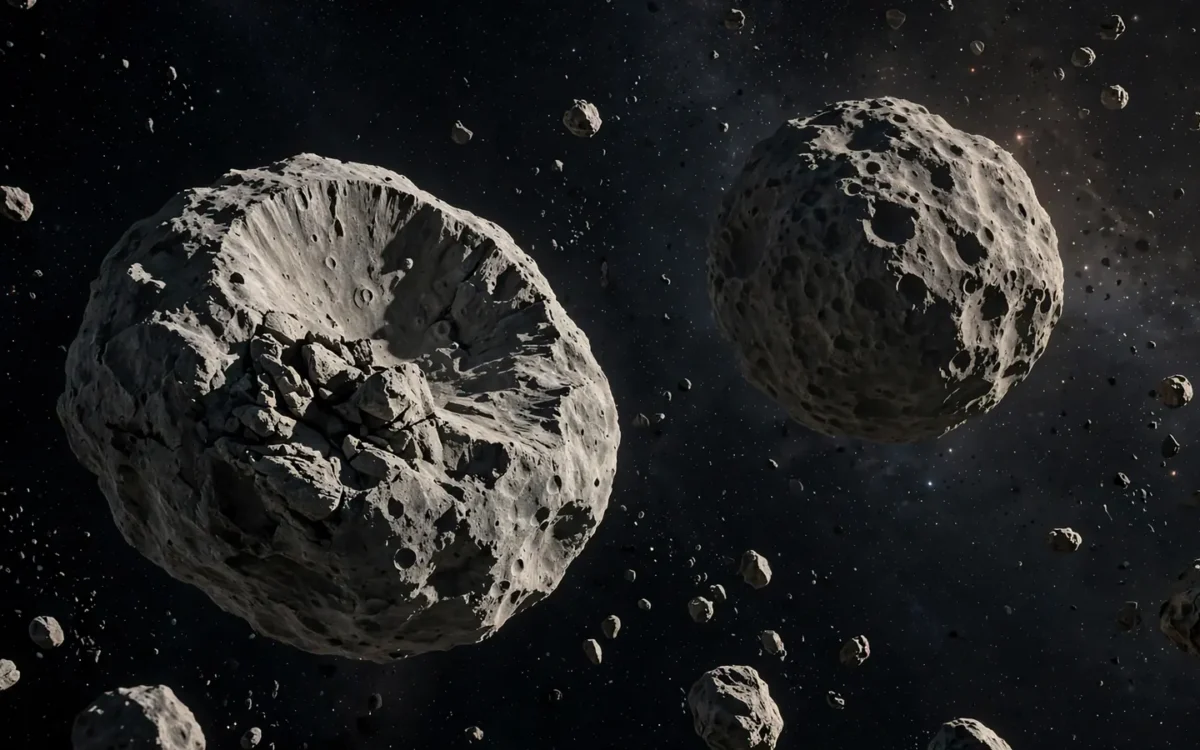
The images show that one whole face of the small asteroid has been flattened into a crater the size of a sports stadium. The impact also knocked Dimorphos into a chaotic tumble and scattered hundreds of boulders around the asteroid pair. The pictures were unveiled on November 25, 2026, at the Museum für Naturkunde in Berlin, Germany.
For planetary defence, this matters a great deal. NASA’s DART mission proved in 2022 that a spacecraft impact can change an asteroid’s orbit. Hera is now showing what that impact did to the asteroid itself, and the answer will shape how humanity might one day deflect a genuinely dangerous space rock.
What did Hera find on Dimorphos?
Hera found a transformed world. Dimorphos is a moonlet about 151 metres wide, orbiting the larger asteroid Didymos, which measures about 730 metres across. Before the impact, Dimorphos looked rounded. Now the side struck by DART has been flattened into a crater that stretches across the entire width of the impacted face.
Scientists had debated three possibilities before Hera arrived. The impact might have dug a crater, changed the asteroid’s shape, or left it largely unchanged. As Physics World reported the first close-up images, the answer turned out to be all three at once, in the words of Hera principal investigator Patrick Michel.
“Scientists debated whether Dimorphos had sustained an impact crater, changed its shape or stayed the same,” said Michel, of CNRS and the Observatoire de la Côte d’Azur. “Much to our surprise the answer turns out to be all three at once! The face struck by DART has been flattened into an impact crater the size of a sports stadium, which extends across the asteroid’s entire width.”
Why is Dimorphos tumbling?
As Hera returned more images, a second surprise became clear. The DART impact has left Dimorphos tumbling wildly in its orbit around Didymos, rather than rotating in the orderly way it did before.
Hera mission scientist Michael Kueppers explained the finding as the images came in. A tumbling asteroid is harder to predict and harder to model, which makes the data valuable. If humanity ever needs to deflect a real asteroid, knowing how the target reacts after an impact is just as important as knowing how to hit it.
The system is currently about 193.5 million kilometres from Earth. Hera is flying about 25 to 30 kilometres from the two asteroids, using its thrusters to hold rectangular orbits around them at an average speed of just 12 centimetres per second.
What are the hundreds of boulders around the asteroids?
Another big surprise is the debris. Hera’s images show hundreds of previously unknown boulders, each a few metres across, orbiting the Didymos-Dimorphos pair. A composite made from 11 long-exposure images taken on November 3, from about 29.9 kilometres away, reveals the swarm in motion.
Immediately after the DART impact, telescopes on Earth captured a plume of ejected material stretching out like a comet’s tail. Much of that material has since dispersed, but Hera shows that a large amount of rock stayed close to the system and is still circling it four years later.
The boulders are a practical problem as well as a scientific find. “The team will have to take account of these objects in the coming weeks as the mission moves in closer to acquire higher-resolution images of the asteroids,” Kueppers said. Hera will move closer over the next few weeks, and in January it will deploy two shoebox-sized CubeSats that will venture closer still.
How did the DART impact work?
NASA’s Double Asteroid Redirection Test, known as DART, slammed into Dimorphos on September 26, 2022, at a speed of 6.1 kilometres per second. The mission cost about $330 million and was the first test of kinetic impactor technology for planetary defence.
A month later, NASA confirmed that the impact had shortened Dimorphos’ orbit around Didymos by more than 33 minutes, from 11 hours and 55 minutes to 11 hours and 23 minutes. That proved the basic idea worked: a spacecraft can push an asteroid onto a different path.
But the orbit change was only part of the story. Until Hera arrived, no one knew how much damage the impact had done to the asteroid itself, or how the ejected rock had behaved. That is the gap Hera was built to fill.
What is Hera doing now?
ESA launched the €360 million Hera mission in October 2024 to carry out a close-up crash-scene investigation. The small, car-sized spacecraft carries 12 instruments, including cameras and thermal-infrared imagers. ESA’s announcement of the crater discovery describes the first images as the beginning of the investigation, not the end of it.
Its instruments include the monochrome Asteroid Framing Camera, the multi-spectral HyperScout-H, which observes in 25 separate colours, and the Thermal Infrared Imager from the Japan Aerospace Exploration Agency, known as TIRI.
Hera will examine both asteroids in detail over the next six months. The two CubeSats, named Milani and Juventas, will go closer still in January, and Hera will keep moving in for higher-resolution views. The detailed survey should turn a one-off experiment into a reliable method.
The story connects with earlier coverage of the mission. Hera’s arrival at the Didymos system was reported here in November, and these first images are the payoff from that arrival. The new pictures also sit alongside other deep-space work, including the Euclid telescope’s record-breaking quasar observations and Voyager 1’s journey into interstellar space. Readers can find more Science and Innovation stories in the same section.
Why does this matter for planetary defence?
No known asteroid threatens Earth today, but the risk is real enough that space agencies take it seriously. The dinosaurs at Berlin’s natural history museum, where Hera’s images were unveiled, are a fitting reminder of what an impact can do.
“NASA’s DART mission demonstrated that we can change an asteroid’s orbit. Hera is now revealing what happened to the asteroid itself,” said Hera mission manager Ian Carnelli. “By combining these two missions, humanity is taking a decisive step towards making asteroid deflection a reliable tool for protecting our planet.”
The crater, the tumble and the boulder swarm all feed into that goal. A deflection plan must predict the damage, the debris and the changed rotation that follow, and Hera’s survey will supply those numbers.
Frequently Asked Questions
What is the Dimorphos crater that Hera found?
The Dimorphos crater is a stadium-sized impact crater covering the face of the asteroid Dimorphos that NASA’s DART spacecraft struck in 2022. Hera’s first close-up images, released on November 25, 2026, show that the crater spans almost the entire width of the impacted face, flattening the asteroid’s once-rounded shape.
How big are Dimorphos and Didymos?
Dimorphos is about 151 metres wide, while its companion Didymos is about 730 metres wide. Dimorphos orbits Didymos, and the pair is currently about 193.5 million kilometres from Earth. DART struck Dimorphos on September 26, 2022, at 6.1 kilometres per second.
Why is Dimorphos tumbling after the DART impact?
The force of the DART impact disturbed Dimorphos’ rotation, leaving it tumbling chaotically in its orbit around Didymos. Scientists discovered this as Hera returned more images, and it is a key finding for understanding how an asteroid reacts to a deflection attempt.
What are the boulders Hera found around the asteroids?
Hera found hundreds of previously unknown boulders, each a few metres across, still orbiting the Didymos-Dimorphos system four years after the impact. They are rock blasted loose by the DART collision. The team must track them carefully as Hera moves closer, so the spacecraft can navigate safely.
What happens next for the Hera mission?
Hera will move closer to the asteroids in the coming weeks for higher-resolution images, and in January it will deploy two shoebox-sized CubeSats, Milani and Juventas, to investigate at close range. The detailed survey will continue for about six months, building a full picture of the impact’s effects.